
Recovering from a fever, flu-like illness, respiratory infection or another acute illness can be reassuring. But recovery does not always follow a straight line.
Sometimes symptoms return after improving. In other situations, a new symptom appears that was not present initially. While some changes may be part of normal recovery, certain symptoms can indicate that the illness is worsening or that a complication has developed.
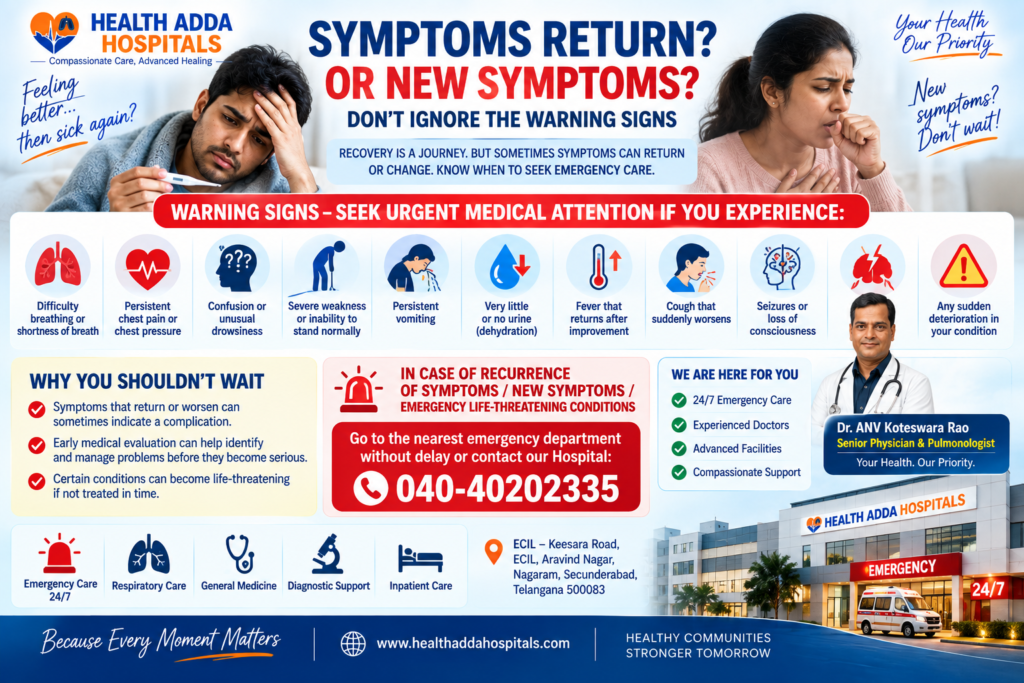
If symptoms recur, new concerning symptoms appear, or there is an emergency or life-threatening condition, do not delay medical attention. Go to the nearest emergency department or contact Health Adda Hospitals at 040-40202335.
This is particularly important when symptoms involve breathing, consciousness, circulation, severe pain, dehydration or a sudden deterioration in overall condition.
Why Symptoms Returning After Improvement Should Not Be Ignored
One important warning pattern is:
“I was getting better, but now I am getting worse again.”
For example, a person may initially have fever and cough, begin to feel better, and then develop:
- Fever again
- Worsening cough
- Difficulty breathing
- Chest pain or pressure
- Severe weakness
- Confusion or unusual drowsiness
- Persistent vomiting
- Reduced urine output
- Significant dehydration
In respiratory infections, the CDC specifically identifies fever or cough that improves and then returns or worsens as an emergency warning sign, particularly when accompanied by other concerning symptoms.
This does not mean that every recurrence represents a serious complication. It means that a significant change after initial improvement deserves medical assessment rather than being automatically dismissed as “just another fever.”
What New Symptoms Should Make You Seek Urgent Medical Attention?
The severity and combination of symptoms matter more than one symptom considered in isolation.
1. Difficulty Breathing or Shortness of Breath
Breathing difficulty is one of the most important emergency warning signs.
Seek emergency medical care if a person develops:
- Difficulty breathing
- Shortness of breath at rest
- Rapid or laboured breathing
- A feeling of not getting enough air
- Bluish or greyish lips or face
- Significant worsening of an existing respiratory condition
Respiratory infections can sometimes cause complications involving the lungs, and people with underlying conditions such as asthma or chronic lung disease may be at increased risk of severe illness.
Do not wait at home if breathing is becoming difficult.
2. Chest Pain or Persistent Chest Pressure
Chest pain should not automatically be attributed to coughing, fever or muscle aches.
Emergency assessment is particularly important when chest pain is:
- Severe
- Persistent
- Associated with breathing difficulty
- Associated with sweating, weakness or dizziness
- Associated with fainting or confusion
- Accompanied by a significant deterioration in overall condition
Persistent chest pain or pressure is listed among emergency warning signs for serious respiratory illness.
3. Confusion, Unusual Drowsiness or Difficulty Waking
Changes in consciousness or mental alertness require urgent evaluation.
Seek emergency care if someone becomes:
- Confused
- Difficult to wake
- Unusually drowsy
- Disoriented
- Unable to respond normally
- Suddenly behaving differently
These symptoms can occur with serious infections and other medical emergencies. WHO identifies confusion, difficulty breathing and reduced urine output among important warning signs associated with sepsis, a medical emergency.
4. Severe Weakness or Inability to Stand or Walk Normally
Fatigue can accompany many infections.
However, severe or rapidly worsening weakness is different from ordinary tiredness.
Urgent medical assessment is appropriate when a person:
- Becomes extremely weak
- Is unable to stand safely
- Becomes unsteady
- Has difficulty performing basic activities
- Becomes progressively less responsive
- Experiences weakness together with breathing difficulty, dizziness or chest symptoms
Severe weakness or unsteadiness is included among emergency warning signs for respiratory viral complications.
5. Persistent Vomiting or Signs of Dehydration
Repeated vomiting can make it difficult to maintain adequate fluid intake.
Watch for:
- Repeated or persistent vomiting
- Inability to keep fluids down
- Very little or no urine
- Severe dizziness
- Dry mouth
- Increasing weakness
- Confusion
Reduced urination and dehydration can become serious, particularly when combined with fever or infection. Emergency warning guidance includes not urinating as a reason for immediate medical assessment in adults.
6. Fever or Cough That Returns After Improvement
This deserves special attention during the current period of respiratory and fever-related illnesses.
A typical recovery may involve symptoms gradually improving.
But if:
Fever improves → patient feels better → fever returns
or
Cough improves → then becomes significantly worse
the change should not simply be ignored.
The CDC specifically lists fever or cough that improves and then returns or worsens among emergency warning signs of respiratory-virus complications.
The underlying cause cannot be determined from symptoms alone. A physician may need to assess the patient and decide whether further examination or testing is appropriate.
7. Seizures or Loss of Consciousness
A seizure, fainting episode, prolonged unresponsiveness or loss of consciousness requires emergency medical evaluation.
Do not attempt to manage such an event as an ordinary fever symptom.
Seek emergency medical care immediately.
Seizures and inability to awaken are included among emergency warning signs in respiratory illness guidance.
8. Symptoms That Suddenly Become Much Worse
Sometimes the most important warning sign is simply a rapid change in the patient’s condition.
For example:
A patient who was talking normally becomes confused.
A patient who was walking becomes extremely weak.
A patient who had a mild cough develops significant breathing difficulty.
A patient whose fever had settled develops high fever again with worsening symptoms.
A patient who was drinking normally becomes unable to keep fluids down.
These changes should prompt medical evaluation rather than prolonged observation at home.
What About Children?
Children can sometimes deteriorate differently from adults.
Parents and caregivers should seek urgent medical care when a child develops signs such as:
- Fast or difficult breathing
- Bluish lips or face
- Chest pain
- Ribs pulling in with each breath
- Severe dehydration
- Very low urine output
- Lack of alertness
- Seizures
- Fever that returns with worsening cough
- Significant worsening of an existing medical condition
The CDC recommends immediate medical attention for these types of emergency warning signs in children.
For very young infants, fever itself can require urgent medical assessment.
What About Older Adults and People With Existing Health Conditions?
Some people have a higher risk of complications from respiratory infections and other acute illnesses.
Extra caution is appropriate for people who have conditions such as:
- Asthma
- Chronic respiratory disease
- Heart disease
- Diabetes
- Kidney disease
- Other significant chronic medical conditions
Older adults can also present with less typical symptoms. Instead of an obvious high fever, they may develop weakness, confusion, reduced appetite or a sudden deterioration in function.
The CDC identifies older adults and people with certain chronic conditions among groups at increased risk of serious complications from influenza.
When Is It an Emergency Versus a Routine Doctor Visit?
Not every new symptom requires an emergency department visit.
A useful distinction is:
🚨 Seek emergency care immediately
When there is:
- Severe breathing difficulty
- Persistent chest pain or pressure
- Blue/grey lips or face
- Confusion or inability to wake
- Seizures
- Severe dehydration or no urine
- Sudden severe weakness
- Rapid deterioration
- Loss of consciousness
- Other symptoms that appear immediately life-threatening
🩺 Arrange prompt medical evaluation
When symptoms are not immediately life-threatening but are:
- Persisting
- Returning after improvement
- Getting progressively worse
- Accompanied by recurrent fever
- Associated with significant cough or body pain
- Interfering with normal food or fluid intake
- Affecting someone with significant underlying medical conditions
The appropriate level of care depends on the patient’s age, medical history, symptoms and clinical examination.
Don’t Assume Every Returning Fever Is “Just Viral”
Fever can occur with many different illnesses.
Depending on the clinical situation, a physician may consider respiratory infections, influenza and other viral illnesses, bacterial infections, mosquito-borne illnesses and other causes.
Symptoms can overlap considerably.
That is why persistent, recurrent or worsening symptoms should be assessed in context rather than diagnosed solely from a temperature reading.
Why Timely Medical Assessment Matters
A patient may initially have a relatively uncomplicated illness and later develop a complication.
For example, influenza can occasionally lead to complications such as pneumonia and can also worsen underlying chronic conditions.
Similarly, serious infections can progress to systemic complications. WHO describes sepsis as a medical emergency and notes warning signs such as confusion, difficulty breathing, extreme discomfort and reduced urine output.
The purpose of emergency assessment is therefore not simply to “bring down a fever.”
It is to determine whether the patient’s condition requires urgent evaluation, monitoring, investigations or treatment.
What Should You Do If Symptoms Suddenly Return?
If symptoms return after improvement:
Step 1 — Assess the severity
Look for breathing difficulty, chest pain, confusion, severe weakness, dehydration or other emergency warning signs.
Step 2 — Don’t delay if an emergency sign is present
Go to the nearest emergency department without delay.
Step 3 — Contact a healthcare professional when symptoms are concerning but not immediately life-threatening
A clinician can determine whether an examination or further evaluation is required.
Step 4 — Don’t rely solely on self-diagnosis
Fever, cough, body aches and weakness can occur in several different conditions.
Step 5 — Keep relevant information ready
If seeking medical care, tell the healthcare team:
- When symptoms began
- Whether symptoms improved previously
- When symptoms returned
- Highest recorded temperature
- New symptoms
- Existing medical conditions
- Current medications
- Recent medical consultations or tests
This information can help the healthcare team understand the progression of the illness.
Emergency Care in ECIL, Nagaram and East Hyderabad
For residents of ECIL, Nagaram, Kapra, AS Rao Nagar, Kushaiguda, Sainikpuri, Cherlapally and surrounding areas, recognizing emergency warning signs early is important.
If a person develops a potentially life-threatening condition, do not delay emergency care while trying to determine the exact diagnosis at home.
Go to the nearest emergency department without delay.
Health Adda Hospitals
Health Adda Hospitals
ECIL – Keesara Rd, ECIL, Aravind Nagar, Nagaram, Secunderabad, Telangana 500083
Emergency / Hospital Contact:
040-40202335
Website:
www.healthaddahospitals.com
A Simple Rule to Remember
When symptoms return or a new symptom develops, ask:
“Is the patient improving, stable, or getting worse?”
If the person is getting significantly worse — especially with breathing difficulty, chest pain, confusion, severe weakness, dehydration, seizures or loss of consciousness — do not wait. Seek emergency medical care.
Important Medical Disclaimer
This article is intended for general health education and does not replace an examination or diagnosis by a qualified medical professional.
Symptoms can have different causes, and the warning signs described above are not an exhaustive list. If symptoms are severe, rapidly worsening, unusual, or concerning, seek appropriate medical care.
In case of recurrence of symptoms, new symptoms, or emergency/life-threatening conditions, go to the nearest emergency department without delay or contact Health Adda Hospitals at 040-40202335.