
Some symptoms can be managed with a routine medical consultation. Others require immediate medical attention.
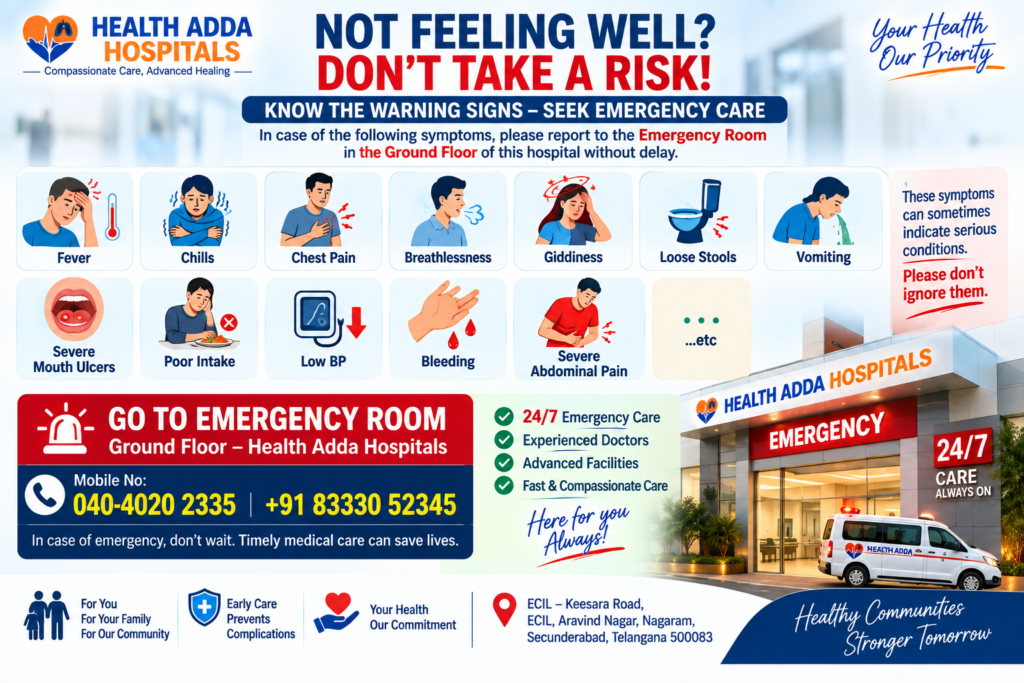
Fever, chills, vomiting or loose stools may sometimes occur with common infections. However, when these symptoms are accompanied by chest pain, breathlessness, giddiness, low blood pressure, bleeding, severe abdominal pain, poor intake or significant deterioration, it may not be appropriate to wait at home.
For patients and families in ECIL, Nagaram, Kapra, AS Rao Nagar, Kushaiguda, Sainikpuri, Cherlapally and surrounding East Hyderabad areas, knowing the warning signs can help them decide when emergency assessment is necessary.
🚨 Important
If you experience a serious or rapidly worsening symptom, report to the nearest emergency department without delay.
At Health Adda Hospitals, the Emergency Room is located on the Ground Floor.
Emergency Contact:
📞 040-4020 2335
📞 +91 83330 52345
What Is an Emergency Warning Sign?
An emergency warning sign is a symptom or change in condition that may indicate a potentially serious medical problem requiring prompt assessment.
The exact cause cannot be determined from symptoms alone.
For example, fever may occur with many infections, while breathlessness may have respiratory, cardiac or other causes. Similarly, vomiting or loose stools may be uncomplicated in some people but can become dangerous when they result in significant dehydration or occur alongside other serious symptoms.
The CDC advises immediate medical care for warning signs such as difficulty breathing, persistent chest or abdominal pain, persistent dizziness or confusion, seizures, inability to urinate, severe weakness and symptoms that improve and then worsen.
WHO also identifies fever or shivering, difficulty breathing, confusion, low blood pressure, weak pulse and reduced urine output among important signs associated with sepsis, which is a medical emergency.
1. Fever With Severe or Worsening Symptoms
Fever itself does not always mean an emergency.
But fever accompanied by significant deterioration deserves attention.
Seek urgent medical evaluation if fever occurs with:
- Severe weakness
- Breathlessness
- Chest pain
- Confusion
- Giddiness or fainting
- Persistent vomiting
- Severe abdominal pain
- Bleeding
- Very poor fluid intake
- Low blood pressure
- Reduced urine output
- Rapid worsening of the patient’s condition
Fever can occur with respiratory infections, gastrointestinal infections, dengue and many other conditions. Symptoms alone cannot establish the diagnosis.
2. Chills or Shivering With Significant Illness
Chills can occur when body temperature is changing and are common with several infections.
However, severe or persistent shivering accompanied by:
- High fever
- Weakness
- Rapid breathing
- Confusion
- Low blood pressure
- Reduced urine output
- Severe body pain
requires medical assessment.
WHO notes that sepsis can present with fever or low temperature and shivering, together with symptoms such as difficulty breathing, confusion, low blood pressure and reduced urine output.
This does not mean that every episode of chills indicates sepsis. The important point is that chills accompanied by significant deterioration should not be ignored.
3. Chest Pain
Chest pain is a symptom that should be taken seriously.
Emergency evaluation is particularly important when chest pain is:
- Persistent
- Severe
- Associated with breathlessness
- Associated with sweating or giddiness
- Associated with fainting
- Accompanied by weakness or confusion
- Associated with severe abdominal or other systemic symptoms
Chest pain can have multiple causes, ranging from relatively minor problems to potentially serious cardiac, pulmonary or other conditions.
It is not possible to determine the cause safely through an online symptom checklist.
If chest pain is severe or persistent, seek emergency medical care.
The CDC lists persistent chest or abdominal pain or pressure among emergency warning signs for serious respiratory illness.
4. Breathlessness or Difficulty Breathing
🫁 Breathlessness should never be casually dismissed.
Go to an emergency department when a person develops:
- Significant shortness of breath
- Difficulty breathing at rest
- Rapid or laboured breathing
- Increasing wheezing with breathing difficulty
- Breathlessness associated with chest pain
- Breathlessness with severe weakness or giddiness
- Blue, grey or unusually pale lips or skin
- Sudden worsening of an existing respiratory condition
People with asthma, COPD and other chronic respiratory conditions may require particular attention when an infection or other illness causes breathing symptoms.
The CDC identifies difficulty breathing or shortness of breath as an emergency warning sign.
5. Giddiness, Fainting or Sudden Weakness
Giddiness can have many causes, including dehydration, low blood pressure and other medical conditions.
Emergency assessment becomes more important when giddiness is:
- Severe
- Sudden
- Associated with fainting
- Associated with chest pain
- Associated with breathlessness
- Associated with confusion
- Associated with significant weakness
- Associated with low blood pressure
Persistent dizziness or confusion is specifically identified as an emergency warning sign in CDC respiratory illness guidance.
6. Loose Stools and Severe Diarrhoea
Loose stools are common with several infections and gastrointestinal illnesses.
The concern increases when diarrhoea is accompanied by:
- Repeated watery stools
- Persistent vomiting
- Poor fluid intake
- Severe weakness
- Giddiness
- Very little urine
- Confusion
- Low blood pressure
- Severe abdominal pain
- Blood in the stool
The major immediate concern can be dehydration and loss of fluids and electrolytes.
If the patient cannot maintain adequate fluid intake or is becoming increasingly weak or dizzy, medical assessment should not be delayed.
7. Persistent or Repeated Vomiting
Occasional vomiting may not necessarily constitute an emergency.
However, seek urgent medical evaluation when vomiting is:
- Persistent
- Repeated
- Preventing adequate fluid intake
- Associated with severe abdominal pain
- Associated with giddiness
- Associated with low blood pressure
- Associated with blood
- Accompanied by significant weakness or reduced urine output
Persistent vomiting is included among warning signs requiring urgent medical attention in CDC emergency guidance.
8. Severe Mouth Ulcers With Poor Intake
Mouth ulcers can occur for many reasons.
But severe mouth ulcers become more concerning when they prevent a person from eating or drinking adequately.
Seek medical assessment if the patient:
- Cannot eat properly
- Cannot drink enough fluids
- Has severe mouth pain
- Is becoming weak
- Is becoming dehydrated
- Has fever or other significant symptoms
- Has recurrent or unusually severe ulcers
Poor intake can contribute to dehydration and nutritional problems, particularly when the illness is already causing fever, vomiting or diarrhoea.
9. Poor Oral Intake
A patient who is sick may naturally eat less for a short period.
The concern arises when the patient is unable to maintain adequate fluid intake.
Watch for:
- Very little drinking
- Dry mouth
- Increasing weakness
- Giddiness
- Reduced urination
- Persistent vomiting
- Confusion
- Low blood pressure
Reduced urine output is an important warning sign in serious illness and sepsis.
10. Low Blood Pressure
Low blood pressure can occur for several reasons, including dehydration and other medical conditions.
When low blood pressure occurs together with:
- Giddiness
- Fainting
- Confusion
- Cold or clammy skin
- Breathlessness
- Severe weakness
- Reduced urine output
- Fever or suspected infection
urgent medical evaluation is particularly important.
WHO identifies low blood pressure, weak pulse, difficulty breathing, confusion and reduced urine output among signs that can accompany sepsis and septic shock.
Do not try to determine the cause of significant low blood pressure at home.
11. Bleeding
Unexpected or significant bleeding should be assessed promptly.
Examples include:
- Vomiting blood
- Coughing blood
- Significant nosebleed that does not stop
- Blood in stools
- Black/tarry stools
- Heavy abnormal bleeding
- Bleeding associated with severe weakness or giddiness
The urgency depends on the amount of bleeding, its source and the patient’s overall condition.
If bleeding is significant or associated with weakness, fainting, low blood pressure or other concerning symptoms, go to the emergency department without delay.
12. Severe Abdominal Pain
Mild abdominal discomfort can have many causes.
But severe, sudden or persistent abdominal pain should not be ignored.
Seek urgent medical assessment if severe abdominal pain is accompanied by:
- Fever
- Repeated vomiting
- Giddiness
- Low blood pressure
- Bleeding
- Abdominal swelling
- Severe weakness
- Confusion
- Inability to eat or drink
Severe abdominal pain is recognized as an emergency symptom in certain serious illnesses, and persistent abdominal pain or pressure is also included in CDC emergency warning guidance.
When Several Symptoms Occur Together
Sometimes the combination of symptoms is more concerning than any one symptom alone.
For example:
Fever + chills + low BP
Requires prompt assessment, particularly if the patient is weak, confused or producing little urine.
Fever + vomiting + poor intake
Raises concern for dehydration, especially if urine output falls.
Chest pain + breathlessness
Requires emergency evaluation.
Giddiness + low BP + weakness
Should not be managed solely at home.
Severe abdominal pain + vomiting
Requires medical assessment, particularly if symptoms are severe or worsening.
Fever + bleeding
Requires prompt medical evaluation because the cause needs to be established.
Breathlessness + confusion
Should be treated as an emergency.
Why You Should Not Wait With Serious Symptoms
The purpose of emergency care is not simply to treat a symptom such as fever.
The emergency team first needs to determine:
- How stable the patient is
- Whether breathing is adequate
- Whether circulation and blood pressure are stable
- Whether the patient is dehydrated
- Whether there are signs of serious infection
- Whether there is a cardiac, respiratory, gastrointestinal or other urgent problem
- Whether investigations or immediate treatment are required
Some serious conditions can progress quickly.
WHO describes sepsis as a medical emergency and emphasizes that early recognition and treatment are important to prevent progression to organ failure and death.
What Should You Do During a Medical Emergency?
1. Don’t wait for symptoms to become unbearable
If the patient has a serious warning sign, seek medical care promptly.
2. Go to the nearest emergency department
Do not spend hours trying to identify the diagnosis yourself.
3. Carry relevant medical information
If available, take:
- Previous medical reports
- Current medication list
- Known allergies
- Recent investigation reports
- Details of existing medical conditions
4. Tell the emergency team what changed
Explain:
- When symptoms started
- Whether they are getting worse
- What symptoms appeared first
- Any fever measurements
- Vomiting or diarrhoea frequency
- Fluid intake
- Urine output
- Any bleeding
- Existing medical conditions
This information can help clinicians understand the progression of the illness.
Emergency Care in ECIL, Nagaram and East Hyderabad
For residents of ECIL, Nagaram, Kapra, AS Rao Nagar, Kushaiguda, Sainikpuri, Cherlapally and surrounding East Hyderabad areas, knowing where to seek urgent medical attention can be important when serious symptoms develop.
Health Adda Hospitals provides 24/7 emergency and trauma care and is located on ECIL–Keesara Road, Aravind Nagar, Nagaram. The hospital’s official website lists emergency support, critical care, ICU services and ambulance coordination.
🏥 Health Adda Hospitals
Emergency Room — Ground Floor
Address:
ECIL – Keesara Road, ECIL, Aravind Nagar, Nagaram, Secunderabad, Telangana 500083
Emergency Contact
📞 040-4020 2335
📞 +91 83330 52345
When Should You Go to the Emergency Room?
A simple rule:
🚨 GO WITHOUT DELAY IF THERE IS:
- Severe breathlessness
- Chest pain
- Fainting or severe giddiness
- Confusion or difficulty staying awake
- Low blood pressure with weakness or other symptoms
- Significant bleeding
- Severe abdominal pain
- Persistent vomiting
- Severe dehydration or very little urine
- Rapid deterioration
- Any other symptom that appears potentially life-threatening
This list is not exhaustive. A symptom that is severe, rapidly worsening or unusual for the patient deserves professional medical assessment.
Final Takeaway
Not every fever, vomiting episode or loose stool is an emergency.
But when symptoms become severe, occur together, or are accompanied by breathlessness, chest pain, giddiness, low blood pressure, bleeding, severe abdominal pain, significant dehydration or rapid deterioration, waiting at home can be unsafe.
Remember:
Serious symptoms → don’t wait.
Breathing difficulty → emergency assessment.
Chest pain → emergency assessment.
Low BP with weakness/giddiness → urgent evaluation.
Significant bleeding → urgent evaluation.
Severe abdominal pain or persistent vomiting → urgent evaluation.
Rapid deterioration → emergency care.
If you or a family member develops a potentially life-threatening condition, go to the nearest emergency department without delay.
Health Adda Hospitals — Emergency Room, Ground Floor
📞 040-4020 2335
📞 +91 83330 52345
Health Adda Hospitals
ECIL – Keesara Road, Aravind Nagar, Nagaram, Secunderabad, Telangana 500083
This article is for general health education and does not replace examination, diagnosis or treatment by a qualified healthcare professional. If symptoms are severe or potentially life-threatening, seek emergency medical care immediately.