
Fever. Dry cough. Sore throat. Body aches. Extreme tiredness.
These symptoms can appear suddenly and may look similar to other viral illnesses.
During the post-monsoon period, people in Hyderabad may experience a range of respiratory infections and influenza-like illnesses. Recent local reporting has highlighted increased flu-like illness and influenza activity, while doctors have also emphasized that influenza, routine viral fever and dengue can overlap in their early symptoms.
For residents of ECIL, Nagaram, Kapra, AS Rao Nagar, Kushaiguda, Sainikpuri, Cherlapally and surrounding East Hyderabad areas, understanding the typical symptoms of influenza—and knowing when symptoms require medical attention—can help families respond appropriately.
The important message is simple:
Not every fever is influenza, and not every influenza infection becomes severe. But severe, worsening or returning symptoms should not be ignored.
What Is Influenza?
Influenza, commonly called flu, is a contagious respiratory infection caused by influenza viruses.
It primarily affects the respiratory tract and can range from mild illness to serious disease.
Typical influenza symptoms often begin relatively suddenly compared with an ordinary cold.
Common symptoms include:
- Fever or feeling feverish
- Chills
- Dry or nonproductive cough
- Sore throat
- Runny or blocked nose
- Headache
- Muscle or body aches
- Fatigue
- Weakness
- Reduced appetite
Some people, particularly children, can also experience vomiting or diarrhoea.
Importantly, not everyone with influenza develops a measurable fever.
Influenza symptoms can overlap with other respiratory infections, which is why a symptom checklist alone cannot establish the diagnosis.
Why Are People Talking About Influenza in Hyderabad?
Hyderabad has experienced seasonal increases in fever and influenza-like illnesses during periods of prolonged monsoon and changing weather conditions.
Recent Hyderabad reporting has described patients presenting with combinations of high fever, dry cough, sore throat, nasal congestion and body aches, while doctors have noted that early differentiation between influenza, routine viral fever and dengue can be difficult.
At the same time, Telangana health-department data reported in September 2026 showed that overall fever admissions were actually lower than the corresponding period of 2025, even though some hospitals were seeing increases in outpatient fever consultations. This is an important distinction: increased flu-like illness reports do not automatically mean that Hyderabad is experiencing an unusually severe outbreak.
Therefore, patients should remain alert without assuming that every fever represents influenza or another specific infection.
What Are the Most Common Influenza Symptoms?
1. Fever or Feeling Feverish
Fever is a common influenza symptom.
It may appear suddenly and can be accompanied by:
- Chills
- Sweating
- Headache
- Body aches
- Weakness
- Fatigue
However, fever alone does not establish that someone has influenza.
Other infections can produce similar symptoms.
2. Dry Cough
A dry cough is one of the symptoms commonly associated with influenza.
It may become persistent and can sometimes continue even after other symptoms start improving.
A cough accompanied by:
- Breathlessness
- Chest pain
- Bluish lips
- Severe weakness
- Confusion
- Rapid deterioration
requires urgent medical assessment.
3. Sore Throat
Influenza can cause throat irritation or soreness.
A sore throat may occur together with:
- Dry cough
- Fever
- Nasal congestion
- Headache
- Body aches
- Fatigue
Because sore throat also occurs with many other viral infections, it cannot by itself distinguish influenza from other causes.
4. Body Aches and Muscle Pain
One feature that can make influenza feel different from an ordinary cold is the degree of body aches and fatigue.
People may describe:
- Muscle aches
- Joint discomfort
- Backache
- Headache
- Generalised weakness
- Difficulty carrying out normal activities
The intensity varies between individuals.
5. Extreme Fatigue
Influenza can leave a person feeling unusually exhausted.
Even after fever improves, tiredness and cough may persist for some time.
Older adults and people with chronic respiratory conditions may experience a longer recovery.
A gradual improvement is generally reassuring, whereas symptoms that improve and then become significantly worse should be medically assessed.
Influenza vs Common Cold
Influenza and the common cold are both respiratory illnesses, but their patterns can differ.
Common cold
Symptoms often develop gradually and may include:
- Sneezing
- Runny nose
- Mild cough
- Sore throat
- Mild fatigue
Influenza
Symptoms more commonly begin suddenly and can include:
- Fever
- Chills
- Significant body aches
- Headache
- Dry cough
- Marked fatigue
- Sore throat
However, there is considerable overlap.
Therefore:
Symptoms can suggest influenza, but symptoms alone cannot always confirm influenza.
A healthcare professional may decide whether testing or additional evaluation is appropriate based on the patient’s clinical presentation and risk factors.
Influenza vs Viral Fever
“Viral fever” is a broad term rather than a specific diagnosis.
Many viral infections can produce:
- Fever
- Headache
- Body pain
- Weakness
- Cough
- Sore throat
Influenza is one specific viral respiratory infection.
This distinction matters because patients should avoid assuming that every fever is simply “viral” without considering the overall pattern and severity.
If fever persists, becomes severe, or occurs with respiratory symptoms, medical evaluation may be appropriate.
Influenza vs Dengue: Why It Can Be Confusing
This is particularly relevant in Hyderabad.
Influenza and dengue can initially share some symptoms, including:
- Fever
- Headache
- Body aches
- Weakness
- Fatigue
However, their overall clinical patterns can differ.
Influenza more commonly produces prominent respiratory symptoms such as:
- Dry cough
- Sore throat
- Nasal congestion
Dengue can be associated with:
- Significant muscle and joint pain
- Headache
- Pain behind the eyes
- Nausea
- Other systemic symptoms
Early symptoms can overlap, however.
Recent Hyderabad medical reporting has specifically noted the difficulty of distinguishing influenza, routine viral fever and dengue early in the illness.
The takeaway:
Do not diagnose yourself based only on fever and body pain.
If symptoms are persistent, severe or unusual, consult a healthcare professional.
Can Influenza Cause Breathing Problems?
Yes.
While many people recover without serious complications, influenza can sometimes cause complications involving the lungs.
These can include pneumonia and worsening of existing respiratory conditions.
People with:
- Asthma
- COPD
- Chronic lung disease
- Heart disease
- Diabetes
- Kidney disease
- Reduced immunity
may have a higher risk of serious complications.
The CDC identifies difficulty breathing or shortness of breath as an emergency warning sign associated with serious influenza or respiratory-virus complications.
Breathlessness should never be dismissed as “just flu.”
If someone is struggling to breathe, seek emergency medical care.
When Should You See a Doctor for Influenza Symptoms?
Not every person with a mild cough and fever needs an emergency department visit.
However, medical evaluation becomes important when:
- Fever is persistent
- Symptoms are becoming worse
- Cough is becoming severe
- Body aches are unusually intense
- The patient is unable to maintain adequate fluid intake
- Significant weakness develops
- Symptoms interfere substantially with normal activities
- The patient belongs to a higher-risk group
- Fever or cough improves and then returns or worsens
The clinical situation, age, medical history and severity of symptoms all matter.
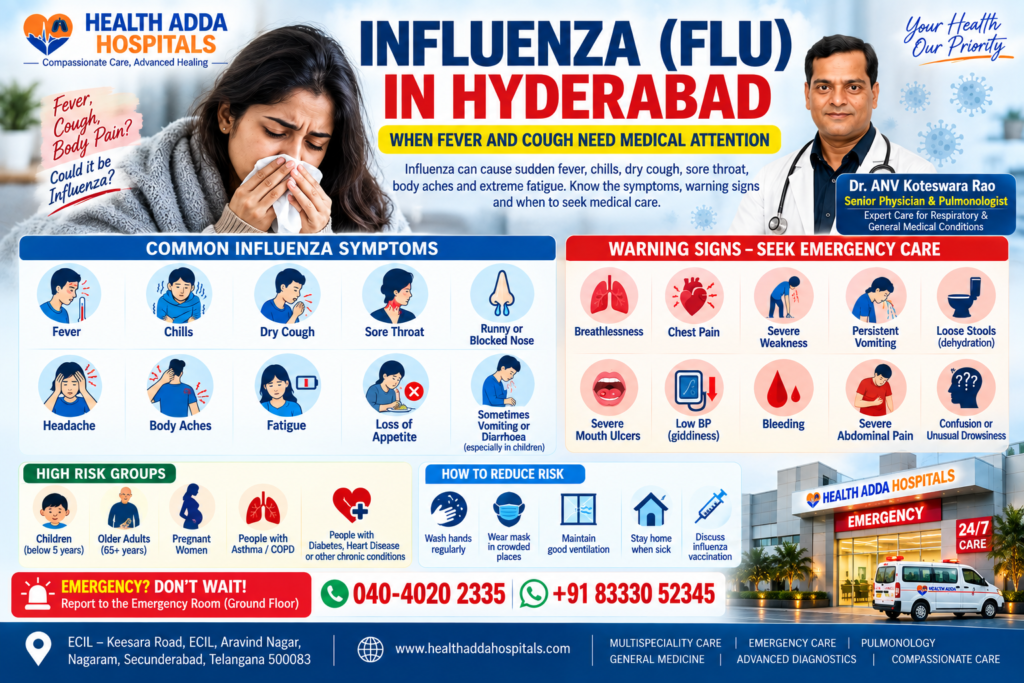
🚨 Emergency Warning Signs of Influenza
Certain symptoms require immediate medical attention.
For adults, these include:
🫁 Difficulty breathing
Shortness of breath, laboured breathing or significant respiratory distress.
❤️ Persistent chest pain or pressure
Especially when accompanied by breathlessness, sweating, weakness or dizziness.
🧠 Confusion or inability to stay awake
Unusual drowsiness, confusion or difficulty waking should not be ignored.
💧 Severe dehydration
Warning signs can include very little or no urine, severe weakness or inability to maintain fluid intake.
⚠️ Severe weakness or unsteadiness
A sudden inability to stand or walk normally requires assessment.
🌡️ Fever or cough that improves and then returns
A person who begins to recover and then develops worsening fever or cough should be reassessed.
⚡ Seizures or loss of consciousness
These require emergency care.
The CDC specifically lists these symptoms among emergency warning signs of serious influenza or respiratory-virus complications.
Influenza in Children
Children can develop influenza with symptoms such as:
- Fever
- Cough
- Sore throat
- Fatigue
- Headache
- Muscle aches
- Reduced appetite
Some children may also develop:
- Vomiting
- Diarrhoea
- Irritability
Parents should pay particular attention to breathing.
Seek immediate medical care if a child develops:
- Fast or difficult breathing
- Bluish lips or face
- Chest pain
- Ribs pulling inward while breathing
- Severe dehydration
- Lack of alertness
- Seizures
- Severe muscle pain
- Fever or cough that improves and then returns or worsens
Very young children and children with chronic medical conditions may require additional caution.
Influenza in Older Adults
Older adults may not always present with the classic combination of fever and cough.
They can sometimes develop:
- Weakness
- Reduced appetite
- Confusion
- Functional decline
- Respiratory symptoms
People aged 65 and above are among the groups at increased risk for serious influenza complications.
If an older adult develops sudden respiratory symptoms, marked weakness or a significant change in alertness, medical evaluation should not be delayed.
Influenza and Asthma or COPD
Influenza can aggravate chronic respiratory disease.
For someone living with asthma or COPD, an infection may trigger worsening:
- Cough
- Wheezing
- Breathlessness
- Chest tightness
- Oxygen-related symptoms
A person who normally manages a respiratory condition well but suddenly becomes significantly more breathless should seek medical assessment.
The CDC notes that influenza can worsen chronic medical conditions, including asthma and chronic heart disease.
Does Every Person With Influenza Need an H1N1 Test?
No.
Testing decisions depend on the clinical situation.
Recent expert commentary published by The New Indian Express noted that routine H1N1 testing for every person with fever is not necessarily required; clinical assessment and appropriate investigations may be sufficient in many situations.
A healthcare professional may consider testing when the result would influence clinical management, infection-control decisions or care of a higher-risk patient.
Therefore:
Don’t demand a specific test simply because you have a fever.
At the same time:
Don’t delay medical assessment when symptoms are severe simply because testing has not yet been performed.
Are Antibiotics Used for Influenza?
Influenza is caused by a virus.
Antibiotics do not treat the influenza virus.
This is an important reason to avoid self-prescribing antibiotics whenever fever or cough appears.
Antibiotics may have a role when a healthcare professional identifies a bacterial infection or bacterial complication, but they should not be used simply because someone has influenza-like symptoms.
Recent Hyderabad and national reporting has also highlighted concerns about inappropriate antibiotic use during seasonal viral illnesses.
Don’t start antibiotics on your own.
Discuss treatment with a qualified medical professional.
What About Antiviral Medicines?
Antiviral medicines may be used for influenza in appropriate patients.
Their use depends on factors such as:
- Severity of illness
- Duration of symptoms
- Age
- Pregnancy
- Underlying medical conditions
- Risk of complications
- Whether the patient requires hospital care
For people at higher risk of serious influenza complications, CDC guidance recommends contacting a healthcare provider early because antiviral treatment is most beneficial when started promptly.
Some reports have highlighted the importance of the first 48 hours after symptom onset for higher-risk patients, but antiviral treatment decisions should be made by a qualified clinician rather than through self-medication.
How Does Influenza Spread?
Influenza is contagious.
It can spread when an infected person:
- Coughs
- Sneezes
- Talks
- Has close contact with others
Transmission is more likely in crowded or poorly ventilated indoor environments.
A person can also spread influenza before realizing they are sick.
This makes household and workplace respiratory hygiene important.
How Can Families Reduce the Spread?
Practical measures include:
🧼 Wash hands regularly
Especially after coughing, sneezing or touching potentially contaminated surfaces.
😷 Follow respiratory etiquette
Cover coughs and sneezes appropriately.
🏠 Stay home when sick
Avoid unnecessary close contact with others while actively ill.
🌬️ Improve ventilation
Fresh air and cleaner indoor air can reduce exposure to respiratory viruses.
🧴 Clean frequently touched surfaces
Especially in households where multiple people are sick.
💉 Discuss influenza vaccination
Annual influenza vaccination can reduce the risk of influenza illness and serious complications. Current CDC guidance recognizes vaccination as an important prevention strategy.
Is Influenza Seasonal in India?
Influenza circulation in India can occur throughout the year, but seasonal patterns vary by region.
CDC’s India guidance notes that influenza activity in India has substantial geographic and seasonal variation, with post-monsoon activity being important in several parts of the country.
For Hyderabad, this means respiratory illnesses can be relevant during periods of changing weather and seasonal transition.
That does not mean every fever during the monsoon or post-monsoon period is influenza.
When Should ECIL Residents Seek Emergency Care?
For people living in ECIL, Nagaram, Kapra, AS Rao Nagar, Kushaiguda, Sainikpuri and surrounding East Hyderabad areas, seek emergency medical care without delay if influenza-like illness is accompanied by:
🚨 Severe breathlessness
🚨 Persistent chest pain or pressure
🚨 Confusion
🚨 Difficulty staying awake
🚨 Seizures
🚨 Severe weakness or inability to stand
🚨 Significant dehydration or very little urine
🚨 Bluish lips or face
🚨 Rapid deterioration
🚨 Fever or cough that improves and then becomes significantly worse
These warning signs can indicate a complication requiring urgent evaluation.
When Should You See a Doctor Even If It Isn’t an Emergency?
A routine or prompt medical consultation can be appropriate when:
- Fever persists
- Cough is getting worse
- Symptoms are not improving
- Body aches are severe
- Fatigue is unusually intense
- Symptoms return after initial improvement
- You have asthma or COPD
- You are pregnant
- You are an older adult
- A young child is unwell
- You have diabetes, heart disease, kidney disease or another chronic condition
- You are concerned about the severity of the illness
The goal is not to panic about every fever.
The goal is to recognize when the clinical picture is outside a mild illness and obtain appropriate care.
Why Early Medical Assessment Can Matter
Influenza is often self-limited, and many people recover without complications.
But complications can occur.
These can include:
- Pneumonia
- Worsening of asthma or COPD
- Secondary bacterial infection
- Severe respiratory illness
- Dehydration
- Cardiac complications
- Neurological complications
- Sepsis in severe cases
The CDC notes that influenza can sometimes lead to serious complications and can worsen underlying chronic conditions.
The important distinction is:
Most flu cases are not emergencies.
But a patient showing emergency warning signs needs emergency care regardless of what the original diagnosis may be.
Influenza Symptoms in ECIL: What Should You Remember?
If you are in ECIL or surrounding East Hyderabad areas, remember these key points:
Fever + dry cough + sore throat
Could be influenza, but other infections can look similar.
Fever + severe body aches
Influenza is one possibility, but other illnesses must also be considered.
Fever + respiratory symptoms
Medical assessment may be appropriate if symptoms are persistent or severe.
Symptoms improve and then worsen
Do not automatically assume this is normal recovery.
Breathlessness or chest pain
Seek urgent medical attention.
Severe weakness, confusion or dehydration
Seek urgent medical attention.
Health Adda Hospitals — Respiratory & Emergency Care in ECIL
For patients in ECIL, Nagaram, Kapra, AS Rao Nagar, Kushaiguda, Sainikpuri, Cherlapally and surrounding East Hyderabad, Health Adda Hospitals provides access to medical and emergency services.
Dr. ANV Koteswara Rao is a Senior Physician & Pulmonologist, with clinical expertise in respiratory and general medical conditions.
Health Adda Hospitals is located on:
ECIL – Keesara Road, ECIL, Aravind Nagar, Nagaram, Secunderabad, Telangana 500083
Emergency Contact
📞 040-4020 2335
📞 +91 83330 52345
Emergency Room
Ground Floor
For a potentially life-threatening condition, do not wait for a routine consultation.
Go to the nearest emergency department without delay.
Frequently Asked Questions
Is influenza the same as viral fever?
No. Influenza is a specific respiratory infection caused by influenza viruses. “Viral fever” is a broad term used for fever associated with different viral infections.
Does influenza always cause fever?
No. Some people with influenza do not develop a measurable fever.
What are the common symptoms of influenza?
Common symptoms include sudden fever or chills, cough, sore throat, body aches, headache and fatigue. Some children may also have vomiting or diarrhoea.
Can influenza cause breathlessness?
Severe influenza or influenza-related complications can cause breathing difficulty. Breathlessness should be treated as an important warning sign.
Can I take antibiotics for influenza?
Antibiotics do not treat influenza itself because influenza is caused by a virus. Do not self-prescribe antibiotics.
When should I go to the emergency department?
Seek emergency care for symptoms such as significant difficulty breathing, persistent chest pain or pressure, confusion, seizures, severe weakness, severe dehydration, inability to urinate or significant worsening after initial improvement.
Can influenza look like dengue?
Some early symptoms can overlap, particularly fever, headache and body aches. Respiratory symptoms such as dry cough and sore throat are more characteristic of influenza, but clinical evaluation may be needed to distinguish illnesses.
Can children get influenza?
Yes. Children can develop fever, cough, sore throat, fatigue and body aches. Some may also develop vomiting or diarrhoea.
Who is at higher risk of serious influenza complications?
Higher-risk groups include older adults, young children, pregnant women and people with certain chronic medical conditions such as asthma, diabetes and heart disease.
Final Takeaway
Influenza can begin suddenly with fever, chills, dry cough, sore throat, body aches, headache and fatigue.
But those symptoms can overlap with other infections.
For Hyderabad residents, particularly those in ECIL, Nagaram, Kapra, AS Rao Nagar, Kushaiguda and Sainikpuri, the most important thing is not to self-diagnose.
Watch the severity, progression and combination of symptoms.
🚨 Seek emergency medical care if there is:
Breathlessness • Chest pain • Confusion • Severe weakness • Seizures • Severe dehydration • Very little urine • Bluish lips/face • Rapid deterioration • Fever or cough that improves and then worsens
If symptoms are persistent, severe, or concerning, arrange medical evaluation.
🏥 Health Adda Hospitals
ECIL – Keesara Road, ECIL, Aravind Nagar, Nagaram, Secunderabad, Telangana 500083
📞 040-4020 2335
📞 +91 83330 52345
Emergency Room — Ground Floor
This article is for health education and does not replace examination, diagnosis or treatment by a qualified healthcare professional.