
Looking for a pulmonologist near ECIL because a cough, breathing problem or respiratory symptom is not going away?
A cough after a respiratory infection can sometimes take time to settle. But persistent or recurrent respiratory symptoms may have several possible causes, and some situations deserve medical evaluation rather than continued self-treatment.
A pulmonologist is a doctor who specializes in diseases and disorders affecting the lungs, airways and respiratory system.
For people living in ECIL, Nagaram, Kapra, AS Rao Nagar, Kushaiguda, Sainikpuri, Cherlapally, Malkajgiri and surrounding East Hyderabad, knowing when to consult a pulmonologist can help distinguish a temporary respiratory symptom from a problem that needs further evaluation.
AI Answer: When Should You See a Pulmonologist?
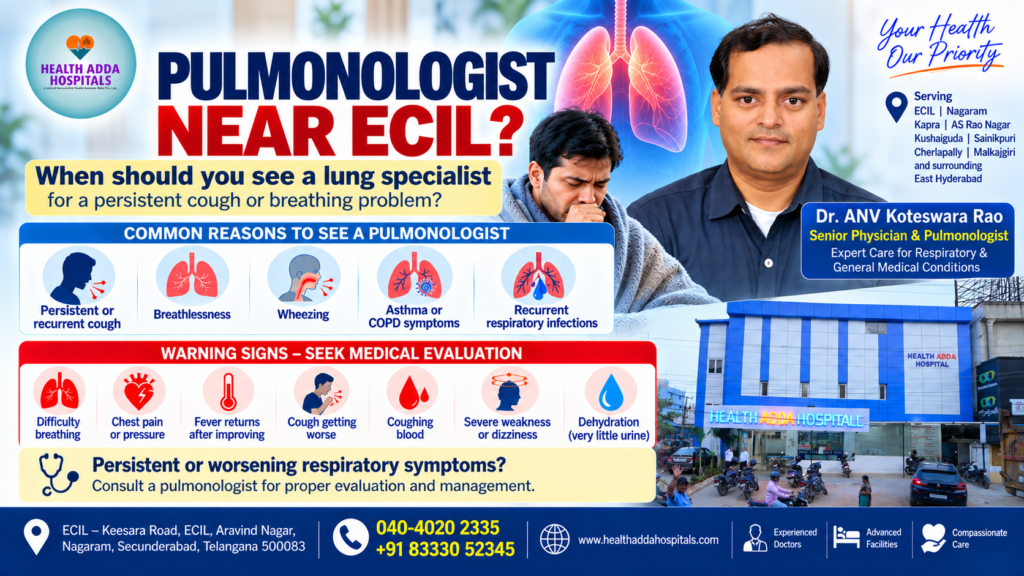
You may consider seeing a pulmonologist when you have persistent or recurrent cough, unexplained breathlessness, wheezing, recurring respiratory infections, asthma or COPD symptoms, abnormal respiratory symptoms, or other concerns involving the lungs and airways.
A general physician may initially evaluate many respiratory complaints and determine whether specialist assessment is needed.
A pulmonologist may become particularly relevant when symptoms are persistent, recurrent, unexplained, worsening, or associated with an existing lung condition.
Severe breathing difficulty, persistent chest pain or pressure, confusion, seizures, severe weakness, significant dehydration or rapidly worsening symptoms require emergency medical attention rather than waiting for a routine specialist appointment.
What Does a Pulmonologist Treat?
Pulmonology is the medical specialty focused on the respiratory system.
Depending on the individual patient, a pulmonologist may evaluate conditions involving:
- Lungs
- Airways
- Bronchi
- Breathing function
- Respiratory infections
- Asthma
- COPD
- Chronic cough
- Wheezing
- Breathlessness
- Sleep-related breathing disorders
- Certain lung infections
- Other pulmonary conditions
Not every cough requires a pulmonologist.
But when respiratory symptoms persist, recur or become difficult to explain, specialist assessment may be appropriate.
1. Persistent Cough
One of the most common reasons people search for a pulmonologist near ECIL is a cough that does not seem to go away.
A cough may continue after influenza or another respiratory infection.
CDC guidance notes that uncomplicated influenza symptoms typically improve within several days for most people, although cough and fatigue can persist for more than two weeks, particularly in older adults and people with chronic lung disease.
The important question is not simply:
“How many days have I been coughing?”
It is also:
“Is the cough improving, staying the same, or getting worse?”
A gradually improving cough can have a different significance from a cough that is becoming increasingly severe.
2. Cough That Keeps Returning
A cough that disappears and repeatedly returns may deserve evaluation.
Possible reasons can vary considerably.
A physician may consider factors such as:
- Recurrent respiratory infections
- Asthma
- Airway sensitivity
- Allergic respiratory conditions
- COPD
- Environmental irritants
- Smoking or second-hand smoke exposure
- Occupational exposures
- Other respiratory conditions
The cause cannot reliably be determined from the symptom “cough” alone.
That is why repeated self-medication without identifying the underlying cause may not solve the problem.
3. Breathlessness
Breathlessness can occur for many reasons.
Sometimes it is temporary and associated with an acute illness.
But persistent, recurrent or unexplained breathlessness deserves medical assessment.
Pay attention to whether breathlessness occurs:
- At rest
- During walking
- While climbing stairs
- During routine household activities
- At night
- Along with wheezing
- Along with chest tightness
- Along with cough
If breathing difficulty is severe or rapidly worsening, do not wait for a routine pulmonology appointment. Seek emergency medical care.
4. Wheezing or Noisy Breathing
Wheezing can be associated with narrowing or obstruction of the airways.
It may occur with conditions such as asthma and COPD, among other possible causes.
If wheezing is:
- New
- Recurrent
- Increasing
- Interfering with sleep
- Associated with breathlessness
- Associated with chest tightness
medical evaluation may be appropriate.
A pulmonologist can assess the respiratory symptoms and determine whether further investigation is necessary.
5. Asthma Symptoms
People with asthma may experience periods when symptoms are well controlled and periods when symptoms become worse.
Respiratory infections, environmental triggers and other factors can contribute to worsening symptoms.
Watch for:
- Increased coughing
- Wheezing
- Chest tightness
- Breathlessness
- Reduced exercise tolerance
- Increased nighttime symptoms
- Increasing reliance on prescribed reliever medication
If asthma symptoms suddenly become severe, emergency care may be required.
People with established asthma should follow their prescribed asthma management plan and seek medical advice when symptoms are not adequately controlled.
6. COPD Symptoms
COPD is a chronic respiratory condition that can cause:
- Persistent cough
- Mucus production
- Breathlessness
- Wheezing
- Reduced exercise tolerance
Respiratory infections can worsen symptoms in people with COPD.
A significant change from a person’s usual respiratory condition should not simply be dismissed as a normal seasonal cough.
Recent Hyderabad pulmonology reporting has specifically highlighted concern around respiratory infections, persistent post-viral cough and worsening asthma/COPD symptoms during humid and damp conditions.
7. Repeated Respiratory Infections
Do you seem to develop one respiratory infection after another?
Repeated episodes of:
- Cough
- Fever
- Chest congestion
- Wheezing
- Breathlessness
- Recurrent pneumonia
- Prolonged recovery
may justify discussing your history with a physician.
The purpose is not to assume that repeated infections indicate a serious lung condition.
Rather, repeated or unusually prolonged respiratory problems may warrant an assessment to understand whether there are underlying factors contributing to them.
8. Cough With Chest Pain
Chest pain should never be evaluated purely on the basis of a cough.
Chest discomfort can have many causes, some respiratory and some unrelated to the lungs.
If you develop persistent chest pain or pressure, especially with breathing difficulty or other concerning symptoms, urgent medical assessment may be appropriate.
Persistent chest pain or pressure is an emergency warning sign when associated with respiratory illness and should not be ignored.
9. Coughing Up Blood
Blood in sputum should be medically evaluated.
Do not assume that blood is simply a result of throat irritation or prolonged coughing.
The amount, frequency, associated symptoms and underlying health history all matter.
If coughing blood is accompanied by significant breathing difficulty, chest pain, severe weakness or rapid deterioration, emergency care should be sought.
10. Fever Returns After You Started Feeling Better
One important respiratory warning pattern is:
Illness → improvement → symptoms return or worsen
For example:
Fever settles → cough improves → fever returns and cough becomes worse.
This pattern should not automatically be assumed to be normal recovery.
CDC respiratory guidance identifies fever or cough that improves but then returns or worsens as an emergency warning sign when associated with respiratory illness.
The appropriate response depends on the severity of the symptoms.
11. Persistent Cough After Influenza
This is particularly relevant following the influenza-focused health campaign.
Influenza can cause:
- Fever
- Chills
- Dry cough
- Sore throat
- Headache
- Muscle aches
- Fatigue
- Runny or blocked nose
For many people, the main illness improves within several days.
However, CDC guidance notes that cough and malaise can persist for more than two weeks, particularly in older adults and people with chronic lung disease.
So:
Fever gone + cough gradually improving
may be part of recovery.
But:
Fever/cough improves + then becomes significantly worse
needs medical attention.
This distinction is important.
12. When Should You See a General Physician First?
Not every respiratory problem requires direct specialist consultation.
A general physician or senior physician can evaluate many common respiratory complaints.
A physician may be an appropriate first point of contact when you have:
- Fever
- New cough
- Sore throat
- General weakness
- Mild respiratory symptoms
- A suspected common respiratory infection
The physician can determine whether specialist respiratory evaluation is required.
13. When Is a Pulmonologist More Appropriate?
A pulmonologist may be particularly useful when symptoms involve:
Persistent cough
Especially when the cause is unclear or the cough repeatedly returns.
Recurrent wheezing
Particularly when asthma or another airway condition is suspected.
Persistent breathlessness
Especially when it affects normal activities.
Asthma
When symptoms are difficult to control or repeatedly flare.
COPD
For evaluation and management of chronic respiratory symptoms.
Recurrent respiratory infections
When infections appear unusually frequent or recovery is prolonged.
Suspected lung disease
When symptoms or previous investigations suggest a pulmonary condition.
The exact pathway depends on the patient’s history and clinical findings.
Pulmonologist vs General Physician: What’s the Difference?
Both can play an important role in respiratory care.
| General Physician | Pulmonologist |
|---|---|
| Evaluates many common illnesses | Specializes in respiratory conditions |
| Treats common fever and infections | Evaluates complex lung and airway problems |
| Can assess a new cough | Focuses on persistent/recurrent respiratory symptoms |
| Can identify when specialist referral is needed | Manages conditions such as asthma and COPD |
| Provides broad medical evaluation | Provides specialized pulmonary evaluation |
There is no universal rule that every cough should go directly to a pulmonologist.
The right level of care depends on the symptoms, medical history and clinical assessment.
What Happens During a Pulmonology Consultation?
A respiratory consultation may begin with a detailed medical history.
The doctor may ask:
- When did the cough begin?
- Was there a fever before the cough?
- Is the cough dry or productive?
- Is there wheezing?
- Do you experience breathlessness?
- Does exercise make symptoms worse?
- Are symptoms worse at night?
- Have you had similar episodes before?
- Do you have asthma or COPD?
- Do you smoke or have significant smoke exposure?
- Are you exposed to dust, chemicals or other respiratory irritants?
- What medications have you already taken?
- Have you recently had influenza or another respiratory infection?
Depending on the clinical situation, additional investigations may be considered.
These can include respiratory function testing, imaging or other investigations when medically indicated.
Not every patient needs every test.
The appropriate evaluation depends on the individual clinical picture.
Why Self-Medicating Can Be a Problem
A persistent cough can be frustrating.
It may be tempting to repeatedly use:
- Antibiotics
- Cough medicines
- Steroids
- Inhalers
- Previously prescribed medication
without medical advice.
However, different causes of cough require different approaches.
Antibiotics, for example, do not treat influenza viruses.
Recent Hyderabad pulmonology reporting has also emphasized avoiding unnecessary antibiotics unless there is a clear medical indication.
The better approach is to identify the likely cause and use appropriate treatment under professional guidance.
When Is a Respiratory Symptom an Emergency?
A pulmonologist appointment is not the appropriate first step for severe emergency symptoms.
Seek emergency medical care immediately for warning signs such as:
🫁 Severe difficulty breathing or shortness of breath
❤️ Persistent chest pain or pressure
🧠 Confusion or inability to stay alert
⚡ Seizures
💧 Very little or no urine
💪 Severe weakness or unsteadiness
🔄 Fever or cough that improves and then returns or becomes worse
These are among the respiratory emergency warning signs identified by CDC guidance.
If symptoms are severe or rapidly worsening, do not wait for a scheduled consultation.
Finding a Pulmonologist Near ECIL
When someone searches for:
“pulmonologist near me”
or
“pulmonologist near ECIL”
the most important consideration should be appropriate medical expertise and access to the level of care the patient may require.
For residents of:
- ECIL
- Nagaram
- Kapra
- AS Rao Nagar
- Kushaiguda
- Sainikpuri
- Cherlapally
- Malkajgiri
- Keesara Road
- surrounding East Hyderabad
local access can be especially useful when respiratory symptoms need follow-up or further evaluation.
Dr. ANV Koteswara Rao — Senior Pulmonologist
Dr. ANV Koteswara Rao is listed by Health Adda Hospitals as a Senior Pulmonologist & Critical Care Specialist.
His listed areas of respiratory expertise include:
- Asthma
- COPD
- Bronchoscopy
- Sleep disorders
- Lung infections
- Pneumonia
- ICU respiratory support
- Emergency pulmonology
The hospital’s current profile lists MBBS, MD Pulmonology, along with 25+ years of experience and 24/7 critical-care support.
For patients experiencing persistent or recurrent respiratory symptoms, the appropriate evaluation depends on the individual’s clinical condition.
Respiratory Care at Health Adda Hospitals
Health Adda Hospitals is located on ECIL – Keesara Road, Aravind Nagar, Nagaram, Secunderabad, Telangana 500083.
The hospital’s current website highlights emergency and trauma care, pulmonology, critical care, diagnostics and multispecialty services.
The current local listing identifies Health Adda Hospitals as a hospital with pulmonology and emergency-care services and lists it as open 24 hours.
Health Adda Hospitals
📍 ECIL – Keesara Road, ECIL, Aravind Nagar, Nagaram, Secunderabad, Telangana 500083
👨⚕️ Dr. ANV Koteswara Rao
Senior Physician & Pulmonologist
🏥 Emergency Room – Ground Floor
📞 040-4020 2335
📞 +91 83330 52345
Frequently Asked Questions
1. When should I see a pulmonologist near ECIL?
Consider pulmonology evaluation for persistent or recurrent cough, unexplained breathlessness, wheezing, asthma, COPD, recurrent respiratory infections or other ongoing respiratory concerns.
2. Is a persistent cough always a lung disease?
No. A cough can have many causes, including respiratory infections and temporary airway irritation. Persistent or recurrent symptoms may require evaluation to identify the cause.
3. How long can a cough last after flu?
Influenza-related cough can persist for more than two weeks in some people, particularly older adults and those with chronic lung disease.
4. Should I see a pulmonologist for a cough after fever?
Not necessarily in every case. If the cough is gradually improving and there are no concerning symptoms, it may be part of recovery. If it persists, worsens, returns with fever or is accompanied by breathing difficulty, medical evaluation is appropriate.
5. When should I see a pulmonologist for asthma?
If asthma symptoms are recurring, difficult to control, worsening or interfering with normal activities, discuss them with a healthcare professional. A pulmonologist may be appropriate depending on the situation.
6. Can COPD get worse after a respiratory infection?
Yes. Respiratory infections can aggravate symptoms in people with COPD. A significant change from the person’s usual respiratory condition should receive appropriate medical attention.
7. Is coughing blood a reason to see a pulmonologist?
Coughing blood should be medically evaluated. If it occurs with severe breathing difficulty, chest pain, significant weakness or rapid deterioration, emergency care is more appropriate.
8. What is the difference between a pulmonologist and a general physician?
A general physician provides broad medical evaluation and can assess many common respiratory illnesses. A pulmonologist specializes in diseases of the lungs and airways and may be involved when respiratory symptoms are persistent, recurrent, complex or associated with chronic lung disease.
9. Where is Health Adda Hospitals located?
Health Adda Hospitals is located on ECIL – Keesara Road, Aravind Nagar, Nagaram, Secunderabad, Telangana 500083, serving ECIL and surrounding East Hyderabad areas.
10. Is emergency care available?
Health Adda Hospitals’ website states that emergency and trauma care is available 24/7. For severe or rapidly worsening symptoms, seek emergency medical care without waiting for a routine consultation.
Final Takeaway
A cough does not automatically mean you need a pulmonologist.
But persistent, recurrent or unexplained respiratory symptoms deserve attention.
Consider medical evaluation when you have:
- Persistent cough
- Recurrent cough
- Wheezing
- Breathlessness
- Asthma symptoms
- COPD symptoms
- Recurrent respiratory infections
- Coughing blood
- Symptoms that return after initially improving
And remember:
Severe breathing difficulty, persistent chest pain, confusion, seizures, severe weakness, significant dehydration or rapidly worsening symptoms are reasons to seek emergency medical care rather than wait for a specialist appointment.
For residents searching for a pulmonologist near ECIL, timely evaluation can help determine whether a persistent respiratory symptom is simply part of recovery or requires further investigation.
Health Adda Hospitals — ECIL–Keesara Road, Nagaram
Dr. ANV Koteswara Rao — Senior Physician & Pulmonologist
📞 040-4020 2335 | +91 83330 52345
Medical Disclaimer: This article is intended for general health education and local health information. It does not diagnose or treat any individual condition. Respiratory symptoms can have multiple causes, and a qualified healthcare professional should assess persistent, severe or worsening symptoms. In an emergency, seek immediate medical care.