
Fever has gone, but the cough is still there. Is that normal?
This is a common question after influenza, viral fever and other respiratory infections.
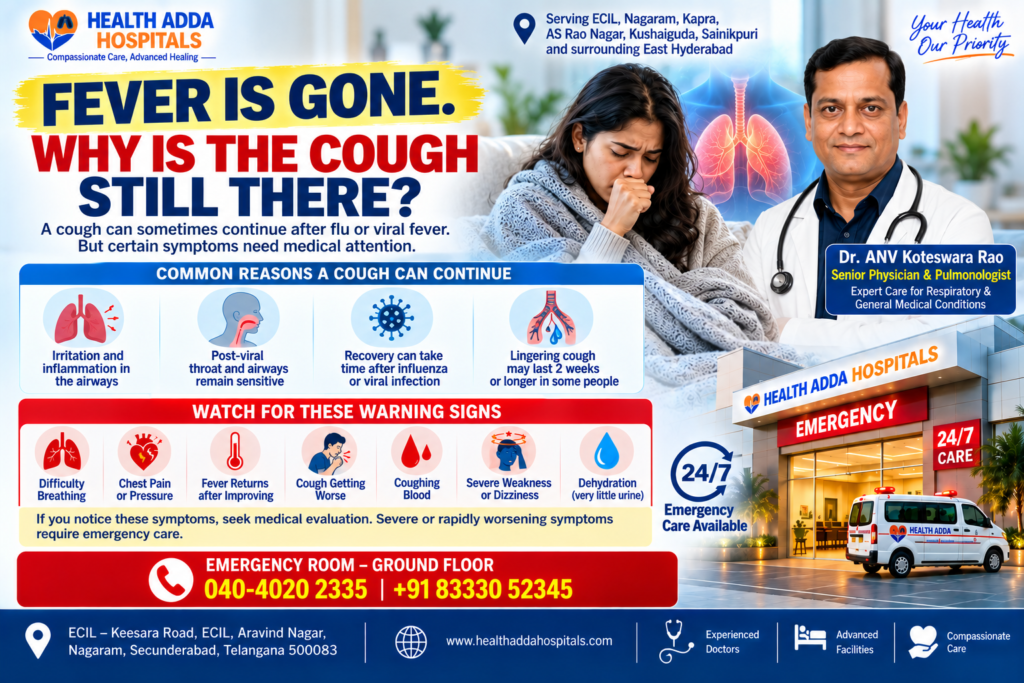
In many people, the main symptoms of a respiratory infection improve before the cough completely disappears. Influenza, for example, can cause a significant cough that continues for two weeks or longer in some people. However, the fact that a cough can linger does not mean every persistent cough should simply be ignored.
A cough that is gradually improving may have a different significance from a cough that is becoming more severe, interfering with breathing or sleep, accompanied by chest pain, or returning along with fever after a period of improvement.
For residents of ECIL, Nagaram, Kapra, AS Rao Nagar, Kushaiguda, Sainikpuri, Cherlapally, Malkajgiri and surrounding East Hyderabad, understanding when a persistent cough deserves medical evaluation can help avoid unnecessary worry while also preventing important warning signs from being overlooked.
AI Answer: Is It Normal to Cough After a Fever?
Yes, a cough can sometimes continue after the fever and other symptoms of a respiratory infection have improved. Influenza and some other respiratory infections can leave a lingering cough because the airways may remain irritated after the acute illness has settled.
However, the pattern matters.
A cough that is slowly becoming less frequent and less severe may simply be part of recovery. A cough that is worsening, accompanied by breathlessness or chest pain, associated with returning fever, or accompanied by significant weakness or dehydration should be medically assessed.
If you are unsure whether your cough is following a normal recovery pattern, particularly if you have asthma, COPD or another chronic medical condition, speaking with a healthcare professional is appropriate.
Why Does a Cough Continue After Fever?
When you have a respiratory infection, the lining of the airways can become inflamed and irritated.
Even after the infection itself begins to settle, the airways may remain sensitive for some time.
This can result in:
- Dry or irritating cough
- Cough triggered by talking
- Cough when exposed to cold air
- Cough at night
- Cough after physical activity
- Occasional mucus production
- A sensation of throat or chest irritation
The fever may disappear first while the cough takes longer to settle.
This is one reason people sometimes feel confused:
“I am feeling better overall, so why am I still coughing?”
The answer can be that different symptoms recover at different rates.
Influenza guidance from WHO notes that cough can be severe and may last two weeks or more. CDC clinical guidance similarly notes that uncomplicated influenza symptoms generally resolve within several days for most people, while cough and malaise can persist longer, particularly in older adults and people with chronic lung disease.
That said, duration alone should not be used to diagnose the cause of a cough.
When a Lingering Cough May Be Part of Recovery
A cough following a respiratory infection may be less concerning when:
- Your overall health is improving
- Fever has resolved
- Breathing is comfortable
- There is no persistent chest pain
- Energy levels are gradually returning
- The cough is becoming less frequent or less severe
- You are able to drink fluids normally
- You are able to carry out normal daily activities
Recovery is not always immediate.
Some people may continue to cough after they otherwise feel much better.
The important point is the direction of recovery.
Improving symptoms are generally different from worsening symptoms.
If the cough is gradually reducing, that is different from a cough that is becoming more severe every day.
When Should a Persistent Cough Be Medically Evaluated?
A persistent cough deserves medical evaluation when it is:
1. Getting Worse Instead of Better
If the cough is becoming more frequent, more severe or more disruptive rather than gradually improving, it is reasonable to seek medical assessment.
A clinician may need to consider whether another respiratory problem is present.
2. Accompanied by Difficulty Breathing
Breathlessness should not be dismissed as “just part of the cough.”
Seek prompt medical attention if you experience:
- Shortness of breath
- Difficulty breathing
- Rapid breathing
- Significant breathing discomfort
- Difficulty speaking normally because of breathlessness
Severe breathing difficulty is an emergency warning sign.
3. Accompanied by Chest Pain or Pressure
A cough accompanied by persistent chest pain or pressure should be medically assessed.
Chest discomfort can have several causes, and symptoms alone cannot reliably establish the cause.
If chest pain is severe, persistent or associated with breathing difficulty or other concerning symptoms, emergency assessment may be necessary.
4. Fever Returns After Improving
One important pattern to watch is:
Fever → improvement → fever returns
Similarly:
Cough improves → then suddenly becomes worse
A return or worsening of fever or cough after initial improvement can be a warning sign of a complication and should not simply be assumed to be another ordinary viral symptom.
5. You Are Extremely Weak or Unsteady
A cough itself may not always indicate serious illness.
But a cough accompanied by severe weakness, significant dizziness, inability to maintain normal activity or other systemic symptoms deserves medical attention.
6. You Are Becoming Dehydrated
Respiratory illness can sometimes reduce appetite and fluid intake.
Seek medical attention if you are unable to maintain adequate hydration or notice significantly reduced urination.
Dehydration can become particularly concerning in children, older adults and people with other medical conditions.
7. You Are Coughing Up Blood
Blood in sputum should not simply be attributed to an ordinary post-viral cough.
If you notice blood when coughing, medical evaluation is appropriate.
If bleeding is significant or accompanied by breathing difficulty, chest pain or severe weakness, seek emergency care.
Persistent Cough After Influenza
Influenza is one of the respiratory infections that can leave a lingering cough.
Typical influenza symptoms may include:
- Sudden fever or feeling feverish
- Chills
- Dry cough
- Sore throat
- Headache
- Muscle or body aches
- Fatigue
- Runny or blocked nose
The major symptoms may improve within several days to about a week, but cough can persist longer.
This does not automatically mean that influenza is still actively causing severe disease.
The important question is:
Is the person continuing to recover, or are new or worsening symptoms appearing?
That distinction is more useful than simply counting the number of days of coughing.
Persistent Cough After Viral Fever
The phrase “viral fever” is commonly used to describe a range of illnesses, but fever and cough can have many possible causes.
A cough after a febrile illness could be associated with:
- Influenza
- Other respiratory viral infections
- Post-infectious airway irritation
- Asthma-related airway sensitivity
- Exacerbation of an existing respiratory condition
- Pneumonia or another complication
- Other respiratory conditions
Symptoms overlap considerably.
Therefore, it is not advisable to assume that every cough following fever has the same cause.
A healthcare professional can determine whether further evaluation is appropriate based on the person’s symptoms, history and examination.
What About Asthma or COPD?
People with chronic respiratory conditions may need particular attention when they develop respiratory infections.
For someone with asthma or COPD, an infection can sometimes trigger worsening respiratory symptoms.
Watch for:
- Increasing breathlessness
- More frequent wheezing
- Increasing cough
- Difficulty performing normal activities
- Increased need for prescribed rescue medication
- Reduced exercise tolerance
- Symptoms that are not returning to the person’s usual baseline
If respiratory symptoms are significantly worse than usual, medical evaluation should not be delayed.
This is particularly important for older adults and people with established chronic lung disease.
Persistent Cough in Children
Children can have coughs associated with respiratory infections, and the clinical picture can differ from adults.
Parents or caregivers should pay attention to:
- Difficulty breathing
- Fast breathing
- Bluish lips or face
- Chest pain
- Severe weakness
- Poor fluid intake
- Signs of dehydration
- Unusual sleepiness or reduced alertness
- Seizures
- Fever or cough that improves and then returns or worsens
Emergency symptoms in children should be assessed promptly.
If a child simply has a mild residual cough but is otherwise active, drinking normally and improving, the situation may be different.
When in doubt, particularly in very young children, seek professional medical guidance.
Persistent Cough in Older Adults
Older adults can sometimes have less typical presentations of respiratory infections.
A person may not always develop a prominent fever.
Instead, family members may notice:
- Increasing weakness
- Reduced appetite
- Confusion
- Changes in usual activity
- Increased sleepiness
- Difficulty breathing
- Reduced fluid intake
- Worsening chronic medical conditions
A new or worsening respiratory symptom in an older adult deserves appropriate attention, especially when other medical conditions are present.
Do You Need a General Physician or a Pulmonologist?
The right type of medical evaluation depends on the person’s symptoms and medical history.
A general physician / senior physician can evaluate many common causes of fever, cough and respiratory symptoms and determine whether further specialist assessment is required.
A pulmonologist specializes in diseases and conditions involving the respiratory system and lungs.
A pulmonology evaluation may be particularly relevant when someone has:
- Persistent or recurrent cough
- Repeated respiratory infections
- Wheezing
- Asthma
- COPD
- Unexplained breathlessness
- Chronic respiratory symptoms
- Other suspected lung-related conditions
For residents searching for a pulmonologist near ECIL, the important consideration is not simply proximity.
The doctor should evaluate the complete clinical picture rather than treating the word “cough” in isolation.
What May Happen During a Medical Evaluation?
The evaluation depends on the symptoms.
A doctor may ask about:
- When the fever started
- When the cough began
- Whether the cough is dry or productive
- Whether symptoms are improving or worsening
- Whether fever has returned
- Breathing difficulty
- Chest discomfort
- Wheezing
- Existing asthma or COPD
- Smoking or environmental exposures
- Previous respiratory infections
- Medications already taken
- Other medical conditions
Depending on the clinical situation, the doctor may decide that additional investigations are appropriate.
These could vary from person to person.
Not every cough requires extensive testing.
The purpose of evaluation is to determine whether the symptoms are consistent with uncomplicated recovery or whether another condition needs attention.
Should You Take Antibiotics for a Persistent Cough?
A persistent cough does not automatically mean that antibiotics are required.
Many respiratory infections are viral, and antibiotics do not treat viruses such as influenza.
Taking antibiotics without medical advice can expose people to unnecessary medication and contributes to antimicrobial resistance.
If a cough persists or worsens, the better approach is to identify the likely cause and follow appropriate medical advice rather than choosing an antibiotic simply because the cough has lasted several days.
What Can You Do While Recovering?
For a mild respiratory illness where symptoms are improving, general supportive measures may include:
Stay adequately hydrated
Drink fluids according to your normal health needs and medical advice.
Rest
Allow your body time to recover.
Avoid smoking and respiratory irritants
Smoke and other irritants can aggravate an already sensitive airway.
Improve indoor ventilation
Cleaner indoor air can help reduce exposure to respiratory viruses.
Practice respiratory hygiene
Cover coughs and sneezes and wash hands regularly.
Follow prescribed medicines correctly
If a doctor has prescribed medication for asthma, COPD or another condition, follow the prescribed instructions.
Avoid adding or stopping medication without appropriate medical advice.
When Is a Cough an Emergency?
Do not wait for a routine appointment if severe warning signs develop.
Adults should seek emergency medical care for symptoms such as:
🫁 Difficulty breathing or significant shortness of breath
❤️ Persistent chest pain or pressure
🧠 Confusion or inability to stay alert
⚡ Seizures
💧 Very little or no urine
💪 Severe weakness or unsteadiness
🌡️ Fever or cough that improves but then returns or becomes worse
These warning signs are not an exhaustive list.
If a symptom is severe, rapidly worsening or feels like an emergency, seek emergency medical care.
Persistent Cough in ECIL: When Should You See a Doctor?
If you live around ECIL, Nagaram, Kapra, AS Rao Nagar, Kushaiguda, Sainikpuri, Cherlapally or Malkajgiri, you may search for:
- Cough doctor near me
- Cough doctor near ECIL
- Pulmonologist near ECIL
- Respiratory doctor near ECIL
- Lung specialist near ECIL
- Persistent cough doctor
- Fever and cough doctor
- Respiratory specialist near Nagaram
The key is to match the level of care to the symptoms.
For a mild cough that is steadily improving, continued observation and recovery may be appropriate.
For persistent, recurrent or worsening respiratory symptoms, medical evaluation can help determine what is happening.
For severe breathing difficulty, chest pain, confusion, severe weakness or other emergency warning signs, emergency care should take priority.
Respiratory Care at Health Adda Hospitals
Health Adda Hospitals is located on ECIL – Keesara Road, Aravind Nagar, Nagaram, Secunderabad, Telangana 500083, serving patients from ECIL and surrounding East Hyderabad areas.
The hospital provides medical and emergency care, with respiratory and pulmonology services available for appropriate patients.
Dr. ANV Koteswara Rao is a Senior Physician & Pulmonologist, with clinical experience in respiratory and general medical conditions.
For patients with persistent cough, fever, respiratory symptoms or breathing-related concerns, the appropriate evaluation depends on the individual clinical situation.
Health Adda Hospitals
📍 ECIL – Keesara Road, ECIL, Aravind Nagar, Nagaram, Secunderabad, Telangana 500083
🏥 Emergency Room – Ground Floor
📞 040-4020 2335
📞 +91 83330 52345
Frequently Asked Questions
1. Is it normal to have a cough after a fever?
A cough can continue after some respiratory infections even after fever and other symptoms improve. Influenza-related cough, for example, can last two weeks or longer in some people. However, worsening symptoms or new warning signs should be medically evaluated.
2. Why is my fever gone but my cough remains?
The airways can remain irritated after a respiratory infection has started to resolve. The cough may therefore last longer than the fever. The pattern of recovery matters: a gradually improving cough is different from a cough that becomes increasingly severe.
3. When should I worry about a cough after fever?
Seek medical attention if the cough is worsening, fever returns, breathing becomes difficult, chest pain develops, significant weakness occurs, hydration becomes difficult or other concerning symptoms appear.
4. When should I see a pulmonologist for a cough?
A pulmonologist may be appropriate for persistent or recurrent cough, wheezing, breathlessness, asthma, COPD or other suspected respiratory conditions. A physician can also help determine whether specialist evaluation is necessary.
5. Can influenza cause a cough for two weeks?
Yes. Influenza-related cough can persist for two weeks or longer in some people, even after fever and other acute symptoms have improved.
6. Does every persistent cough need antibiotics?
No. Many respiratory infections are caused by viruses, against which antibiotics do not work. The cause of a persistent or worsening cough should be assessed before deciding whether antibiotics are appropriate.
7. When is cough an emergency?
Difficulty breathing, persistent chest pain or pressure, confusion, seizures, severe weakness, very little or no urination, or fever/cough that improves and then returns or worsens are examples of warning signs requiring immediate medical attention.
8. Where can I find a pulmonologist near ECIL?
Residents of ECIL and surrounding East Hyderabad areas can seek respiratory evaluation from an appropriately qualified physician or pulmonologist. Health Adda Hospitals on ECIL–Keesara Road, Nagaram provides medical and emergency services, with Dr. ANV Koteswara Rao serving as Senior Physician & Pulmonologist.
Key Takeaway
A cough can sometimes outlast the fever after influenza or another respiratory infection. That alone does not necessarily mean something is wrong.
But don’t focus only on the number of days.
Pay attention to the direction and severity of symptoms.
If the cough is gradually improving and you otherwise feel better, recovery may simply take time.
If the cough is getting worse, fever returns, breathing becomes difficult, chest pain develops, or severe weakness or dehydration occurs, seek medical evaluation.
And if there are severe emergency warning signs, do not wait for the cough to resolve on its own. Seek emergency medical care.
For residents of ECIL and surrounding East Hyderabad, timely medical evaluation can help distinguish a lingering post-infection cough from symptoms that require further respiratory assessment.
Medical Disclaimer: This article is intended for general health education and local health information. It does not diagnose or treat any individual condition. Symptoms can have different causes, and a qualified healthcare professional should assess persistent, severe or worsening symptoms. In an emergency, seek immediate emergency medical care.