
Fever, dry cough, sore throat and body aches can make you wonder: Is this influenza, viral fever or something else?
For residents of ECIL, Nagaram, Kapra, AS Rao Nagar, Kushaiguda, Sainikpuri, Cherlapally and surrounding East Hyderabad areas, finding the right time to seek medical evaluation can be just as important as knowing the symptoms.
Influenza, commonly called flu, can begin suddenly with fever, cough, headache, body aches, sore throat and significant fatigue. But these symptoms can overlap with other viral and respiratory infections.
That means not every fever and cough is influenza.
At the same time, persistent, worsening or severe symptoms should not simply be dismissed as “just viral fever.”
This guide explains when it is reasonable to consult a doctor, when people at higher risk should seek medical attention earlier, and when influenza-like symptoms require emergency care.
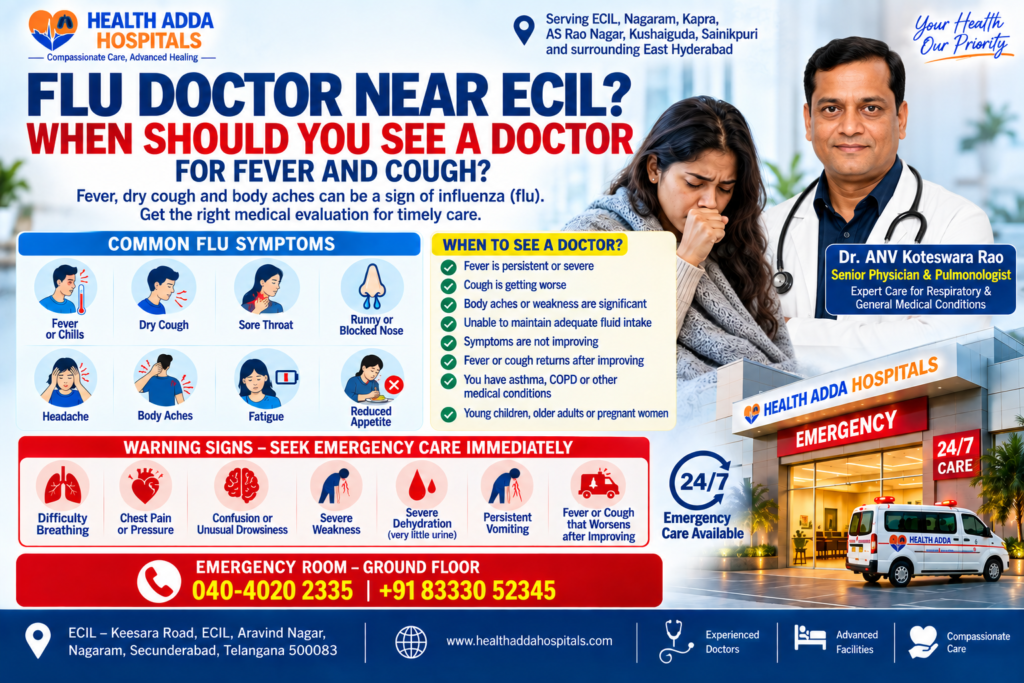
When Should You See a Doctor for Flu-Like Symptoms?
Many people with uncomplicated influenza recover within about a week without needing hospital care. WHO notes that most people recover from fever and other symptoms within a week, although influenza can cause severe illness in people at higher risk.
A medical consultation becomes more important when:
- Fever is persistent or unusually high
- Cough is becoming worse
- Body aches are severe
- Weakness is interfering with normal activities
- You cannot maintain adequate fluid intake
- Symptoms are not gradually improving
- Symptoms improve and then return or worsen
- You have asthma, COPD or another chronic condition
- You are pregnant
- You are an older adult
- A young child is significantly unwell
- You are concerned about the severity or progression of symptoms
The goal of consultation is not simply to confirm “flu.”
A doctor may need to consider influenza, other viral infections, bacterial infections, dengue, other causes of fever, or complications, depending on the clinical picture.
What Does Influenza Usually Look Like?
Influenza commonly has a relatively sudden onset.
Typical symptoms include:
🌡️ Fever
Fever or feeling feverish is common.
😷 Dry cough
The cough can sometimes be significant and may persist after other symptoms improve.
🤕 Headache
Headache can occur along with fever and body aches.
💪 Muscle and joint aches
Influenza can produce pronounced body aches compared with an ordinary cold.
😴 Fatigue
Significant tiredness or malaise is common.
🤧 Sore throat and runny nose
These respiratory symptoms may also occur.
WHO describes sudden fever, usually dry cough, headache, muscle and joint pain, sore throat and runny nose among the characteristic symptoms of seasonal influenza.
Why You Shouldn’t Diagnose Influenza From Symptoms Alone
One of the most common mistakes during fever season is assuming:
Fever + body pain = dengue
or
Fever + cough = influenza
or
Fever = ordinary viral infection
The reality is more complicated.
Several illnesses can produce overlapping symptoms.
Recent Hyderabad reporting has specifically highlighted difficulty distinguishing influenza, routine viral fever and early dengue based only on early symptoms.
The appropriate evaluation depends on:
- Age
- Symptoms
- Duration
- Severity
- Medical history
- Exposure history
- Physical examination
- Local disease patterns
- Whether additional testing is clinically appropriate
Therefore, online information can help you recognize warning signs, but it cannot replace a medical examination.
When Is a Flu Doctor Near ECIL Particularly Important?
A medical consultation is particularly relevant when symptoms are persistent, severe, unusual or worsening.
For example:
Fever That Doesn’t Settle
If fever continues instead of gradually improving, medical evaluation may help determine whether another infection or complication needs consideration.
Cough That Gets Worse
A mild cough may accompany influenza.
But a cough that becomes increasingly severe, particularly when accompanied by breathlessness or chest pain, requires medical attention.
Severe Body Pain or Weakness
Influenza can produce significant body aches.
However, severe weakness that prevents normal activity should not simply be attributed to flu.
Symptoms Return After Improvement
A patient may initially feel better and then experience:
Fever returns → cough worsens → weakness increases
This change should be assessed rather than automatically considered normal recovery.
People Who Should Seek Medical Advice Earlier
Not everyone has the same risk of influenza complications.
WHO identifies several groups at increased risk of severe influenza, including:
- Pregnant women
- Children under 5 years
- Adults aged 65 years and older
- People with chronic heart or lung disease
- People with diabetes and certain other chronic medical conditions
- People with weakened immune systems
For these groups, contacting a healthcare professional early after influenza symptoms develop can be particularly important.
Influenza and Asthma or COPD
For someone with asthma or COPD, a respiratory infection may cause symptoms to become worse.
Watch for:
- Increased cough
- Wheezing
- Chest tightness
- Increased breathlessness
- Difficulty performing normal activities
- Increasing need for prescribed rescue medication
CDC identifies asthma and chronic lung disease among conditions associated with increased risk of serious flu complications.
A person with chronic respiratory disease should not assume that a significant worsening of breathing is simply part of having the flu.
What About Children With Flu Symptoms?
Children can develop:
- Fever
- Cough
- Sore throat
- Body aches
- Headache
- Fatigue
- Reduced appetite
Some children may also experience vomiting or diarrhoea.
Parents should pay particular attention to breathing and hydration.
🚨 Seek urgent medical attention if a child develops:
- Fast or difficult breathing
- Blue or grey lips or face
- Ribs pulling in during breathing
- Chest pain
- Severe dehydration
- No urine for an unusually long period
- Extreme sleepiness or lack of alertness
- Seizures
- Severe muscle pain or inability to walk normally
- Symptoms that improve and then become worse
The CDC identifies breathing difficulty, bluish lips or face, chest pain, severe dehydration and other significant changes as emergency warning signs in children with influenza.
Influenza in Older Adults
Older adults may not always show the classic flu pattern.
Instead, they may develop:
- Weakness
- Reduced appetite
- Confusion
- Functional decline
- Respiratory symptoms
- Increased fatigue
Adults aged 65 years and older are among the groups at increased risk of serious influenza complications.
A sudden change in an older person’s normal behaviour or physical ability deserves attention.
Do You Need an Influenza Test?
Not necessarily.
Testing decisions depend on the clinical situation.
A doctor may determine whether testing is useful based on:
- Severity of symptoms
- Duration of illness
- Risk factors
- Current respiratory illness activity
- Whether the result would change management
- Whether the patient belongs to a high-risk group
Recent Hyderabad reporting also noted that routine H1N1 testing is not required for every patient with fever and that clinical assessment may guide the need for investigations.
The important point is:
Don’t delay urgent medical care simply because a test has not yet been performed.
What About Antiviral Treatment?
Influenza antiviral medicines are prescription treatments.
They are different from antibiotics and work against influenza viruses.
CDC guidance states that antivirals work best when started within the first 1–2 days after symptoms begin, and prompt treatment is particularly important for people at higher risk of serious complications.
WHO similarly notes that antiviral medicines can reduce complications in high-risk patients and work best when started early, ideally within 48 hours.
This does not mean everyone with a cough should obtain an antiviral medicine.
A qualified healthcare professional should decide whether antiviral treatment is appropriate.
Why Antibiotics Are Not Automatically the Answer
Influenza is caused by a virus.
Therefore:
Antibiotics do not treat influenza itself.
Antibiotics are used against bacterial infections.
Taking antibiotics unnecessarily can expose patients to side effects and contributes to antimicrobial resistance.
If a doctor suspects a bacterial infection or complication, antibiotics may be considered as appropriate.
But:
Fever + cough does not automatically mean antibiotics are required.
What Can You Do at Home While Recovering?
For people with mild illness who do not have emergency warning signs, general supportive measures can include:
💧 Maintain fluids
Drink adequate fluids as tolerated.
🛌 Rest
Give your body time to recover.
😷 Reduce close contact
Avoid unnecessary contact with others while actively ill.
🧼 Maintain hand hygiene
Wash hands regularly.
🌬️ Improve ventilation
Fresh air and ventilation can reduce respiratory-virus transmission.
🤧 Cover coughs and sneezes
Use appropriate respiratory hygiene.
WHO recommends staying home when sick, improving ventilation, avoiding crowded closed spaces, covering coughs and sneezes, and maintaining hand hygiene to reduce influenza transmission.
What About Flu Vaccination?
Vaccination is an important influenza-prevention strategy.
WHO identifies annual influenza vaccination as particularly important for people at higher risk of complications, including:
- Pregnant women
- Young children
- Older adults
- People with chronic medical conditions
- Healthcare workers
The exact vaccination recommendation for an individual should be discussed with a qualified healthcare professional, particularly for children, pregnancy and people with chronic medical conditions.
When Does Flu Become an Emergency?
Most influenza cases do not require emergency treatment.
However, certain warning signs require immediate medical attention.
🚨 Go to the emergency department if there is:
🫁 Difficulty breathing
Significant shortness of breath or respiratory distress.
❤️ Persistent chest pain or pressure
Especially when accompanied by breathing difficulty, weakness or dizziness.
🧠 Confusion or unusual drowsiness
Difficulty staying awake or a significant change in alertness.
⚠️ Severe weakness or unsteadiness
Particularly if the patient cannot stand or walk normally.
💧 Severe dehydration
Very little urine, inability to maintain fluids or marked weakness.
⚡ Seizures
A seizure requires emergency assessment.
🔄 Symptoms that improve and then become significantly worse
Especially fever or cough returning with deterioration.
CDC guidance identifies these types of symptoms among emergency warning signs associated with serious influenza complications.
Flu Doctor Near ECIL: Where Can Residents Seek Medical Care?
Residents of ECIL, Nagaram, Kapra, AS Rao Nagar, Kushaiguda, Sainikpuri and surrounding East Hyderabad areas may search online for:
- Flu doctor near ECIL
- Influenza doctor near ECIL
- Fever doctor near ECIL
- Respiratory doctor near ECIL
- Pulmonologist near ECIL
- Fever and cough doctor near me
- Respiratory infection doctor Nagaram
- Hospital near ECIL for fever
The important consideration is not simply finding a doctor with “flu” in the search result.
Look for appropriate medical evaluation based on:
- Symptoms
- Severity
- Age
- Existing health conditions
- Duration
- Progression of illness
Health Adda Hospitals — Medical & Emergency Care Near ECIL
HEALTH ADDA HOSPITALS is located on ECIL–Keesara Road in Nagaram, providing hospital, emergency and pulmonary care services. The facility is listed as operating 24 hours.
Hospital Address
Health Adda Hospitals
ECIL – Keesara Road, ECIL, Aravind Nagar, Nagaram, Secunderabad, Telangana 500083
Emergency Room
Ground Floor
Contact
📞 040-4020 2335
📞 +91 83330 52345
For a potentially life-threatening condition, do not wait for a routine consultation. Go to the nearest emergency department without delay.
A Simple Decision Guide for ECIL Residents
🟢 Mild symptoms and improving
Fever/cough are mild, the person can drink fluids, breathing is comfortable and symptoms are gradually improving.
Continue appropriate supportive care and monitor the illness.
🟡 Persistent or concerning symptoms
Fever continues, cough worsens, weakness is significant, symptoms are not improving, or the patient belongs to a higher-risk group.
Arrange medical evaluation.
🔴 Emergency symptoms
Breathlessness, persistent chest pain, confusion, severe weakness, severe dehydration, seizures or significant deterioration.
Go to the emergency department immediately.
This approach avoids both extremes:
Don’t panic over every cough.
Don’t ignore serious deterioration.
Frequently Asked Questions
Is there a difference between a flu doctor and a general physician?
Influenza is a respiratory infection and can often be assessed by a qualified physician. Depending on the symptoms and complexity, a pulmonologist or other specialist may also be involved.
Should I see a doctor for every fever?
Not necessarily. Many mild viral illnesses resolve without medical attention. However, persistent, severe, worsening or unusual fever should be evaluated.
Is a dry cough a sign of influenza?
A dry cough is common with influenza, but it is not specific to influenza. Other respiratory infections can also cause dry cough.
How quickly should high-risk patients seek medical advice?
People at increased risk of serious influenza complications should contact a healthcare professional early after symptoms begin. Antiviral treatment, when indicated, works best when started early.
Can influenza become pneumonia?
Yes. WHO notes that severe influenza can lead to complications including pneumonia and, in severe cases, sepsis.
Should I take antibiotics for flu symptoms?
Not automatically. Antibiotics do not treat influenza because it is caused by a virus.
When should I go directly to the emergency room?
Go immediately for significant breathing difficulty, persistent chest pain, confusion, seizures, severe weakness, severe dehydration or other potentially life-threatening deterioration.
Final Takeaway
If you are searching for a flu doctor near ECIL, remember that the first question should not simply be:
“Do I have influenza?”
It should be:
“How severe are my symptoms, and are they getting better or worse?”
Mild influenza-like illness often improves with time.
But persistent fever, worsening cough, significant weakness, poor fluid intake or symptoms that return after improvement deserve medical evaluation.
And symptoms such as:
🚨 Breathlessness
🚨 Persistent chest pain
🚨 Confusion
🚨 Severe weakness
🚨 Severe dehydration
🚨 Seizures
🚨 Rapid deterioration
require urgent medical attention.
For residents of ECIL, Nagaram, Kapra, AS Rao Nagar, Kushaiguda, Sainikpuri and surrounding East Hyderabad, Health Adda Hospitals provides medical and emergency services.
🏥 Health Adda Hospitals
Emergency Room — Ground Floor
📍 ECIL – Keesara Road, ECIL, Aravind Nagar, Nagaram, Secunderabad, Telangana 500083
📞 040-4020 2335
📞 +91 83330 52345
If the condition is potentially life-threatening, do not wait for a routine appointment. Go to the nearest emergency department without delay.
This article is for general health education and does not replace examination, diagnosis or treatment by a qualified healthcare professional.