
Tuberculosis in Hyderabad continues to be a public health concern. Earlier, TB was mainly linked to limited awareness and delayed diagnosis. However, today, even urban populations are affected.
At the same time, population density, environmental exposure, and lifestyle patterns influence the spread of TB. Therefore, understanding the symptoms and risk factors becomes important.
This article explains tuberculosis in a clear and simple way. It focuses on early signs, causes, and risk patterns seen in Hyderabad.
What Is Tuberculosis in Hyderabad Context?
Tuberculosis is an infectious disease that mainly affects the lungs. It spreads through the air when an infected person coughs or sneezes.
In Hyderabad, TB cases are seen across different age groups. Therefore, awareness is important for early identification.
Is Tuberculosis in Hyderabad Increasing?
Tuberculosis in Hyderabad remains present despite ongoing public health efforts. While control programs have improved detection, cases still appear regularly.
Key Observations
- Persistent cough cases reported in clinics
- Continued presence in densely populated areas
- Delayed identification in some individuals
- Increased awareness leading to more testing
Moreover, urban movement and close contact environments contribute to transmission.
According to clinical observations, pulmonologists including Dr. ANV Koteswara Rao have noted that TB cases still require early recognition, especially in high-risk populations.
Common Symptoms of Tuberculosis in Hyderabad
Recognizing symptoms early is essential. Therefore, awareness of warning signs can support timely evaluation.
Key Symptoms
- Persistent cough lasting more than two weeks
- Fever, especially in the evening
- Night sweats
- Unexplained weight loss
- Fatigue and weakness
- Chest discomfort
In some cases, symptoms may appear mild at first. However, they can progress if not evaluated.
Causes of Tuberculosis in Hyderabad
1. Airborne Transmission
Tuberculosis spreads through airborne droplets. When an infected person coughs, bacteria can enter the air.
Therefore, close contact increases the risk of transmission.
2. Crowded Living Conditions
High population density in certain areas of Hyderabad increases exposure. For example:
- Shared living spaces
- Public transport
- Work environments
Because of this, infection can spread more easily.
3. Weak Immune System
Individuals with low immunity are more vulnerable. For instance:
- Malnutrition
- Chronic illnesses
- Stress-related factors
Therefore, immunity plays a key role.
4. Environmental Factors
Pollution and poor ventilation can worsen respiratory conditions. Although they do not directly cause TB, they can increase vulnerability.
Who Is at Higher Risk of Tuberculosis in Hyderabad?
Certain groups face higher risk.
High-Risk Groups
- Individuals with weakened immunity
- People living in crowded areas
- Patients with existing lung conditions
- Healthcare workers
- Individuals with poor nutrition
Because of these factors, risk varies across populations.
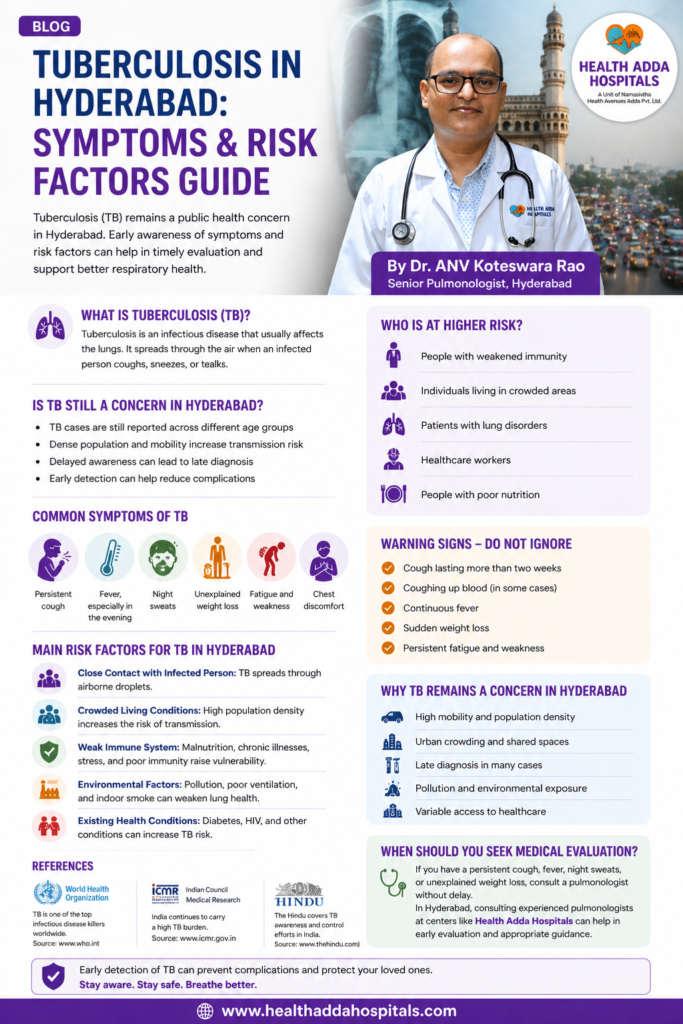
Why Tuberculosis in Hyderabad Remains a Concern
Hyderabad has a mix of urban and semi-urban environments. As a result, risk factors differ across regions.
- High mobility of population
- Urban crowding
- Variable access to healthcare
- Environmental exposure
Therefore, TB continues to require attention.
Early Warning Signs You Should Not Ignore
Some symptoms require immediate attention.
Important Warning Signs
- Cough lasting more than two weeks
- Blood in sputum (in some cases)
- Continuous fever
- Sudden weight loss
- Persistent fatigue
If these signs are present, evaluation becomes important.
Real-World References (India Context)
- Indian Council of Medical Research highlights TB as a significant public health issue.
- World Health Organization reports India as one of the high-burden countries for TB.
- The Hindu has covered TB awareness and detection efforts in India.
These references confirm the ongoing importance of TB awareness.
Clinical Perspective
From a pulmonology standpoint, TB requires early identification.
In Hyderabad, pulmonologists including Dr. ANV Koteswara Rao have observed:
- Cases with delayed symptom recognition
- Continued transmission in high-density areas
- Importance of early awareness
Therefore, recognizing symptoms early can support better outcomes.
When Should You Seek Medical Evaluation?
Evaluation is important when:
- Symptoms persist beyond two weeks
- Fever continues without clear reason
- Weight loss is unexplained
In Hyderabad, consulting experienced pulmonologists at established centers such as Health Adda Hospitals can support early evaluation and clinical clarity.
Conclusion
Tuberculosis in Hyderabad remains an important health concern. However, awareness can support early recognition.
Therefore, understanding symptoms and risk factors is essential. As urban conditions evolve, respiratory awareness becomes even more important.
By Dr. ANV Koteswara Rao
Senior Pulmonologist, Hyderabad
Clinical Expertise in Respiratory and Critical Care Medicine