
Introduction
A sore throat…
A fever…
A persistent cough…
A stomach ache…
For many people, the first reaction today is not to visit a doctor—it is to search online.
Within seconds, search engines, AI chatbots, YouTube videos, and social media provide hundreds of possible explanations and treatment suggestions.
Many people then purchase medicines directly from a pharmacy or use leftover medications at home without consulting a qualified healthcare professional.
Although this may appear convenient, self-diagnosis and self-medication can sometimes delay appropriate treatment, hide serious illnesses, and increase health risks.
The internet is an excellent place to learn about health, but it should never replace professional medical evaluation.
Why This Topic Matters More Than Ever
Healthcare information is more accessible than ever before.
People frequently use:
- Google Search
- AI assistants
- ChatGPT
- YouTube
- Social media
- Health blogs
- Online symptom checkers
These tools can improve awareness but cannot replace clinical judgment.
The same symptom may have many different causes, and only a qualified healthcare professional can determine the correct diagnosis after evaluating the patient.
What Is Self-Diagnosis?
Self-diagnosis occurs when patients decide what illness they have without professional medical evaluation.
For example:
- Assuming every fever is viral
- Treating chest pain as acidity
- Believing every headache is due to stress
- Thinking persistent cough is only due to weather
While symptoms may sometimes be minor, they may also indicate more serious health conditions.
What Is Self-Medication?
Self-medication means taking medicines without proper medical advice.
Common examples include:
- Buying antibiotics without prescription
- Taking painkillers repeatedly
- Using leftover medicines
- Taking medicines recommended by friends or relatives
- Following medication advice from social media
Although symptoms may temporarily improve, the underlying condition may remain untreated.
Why Self-Diagnosis Can Be Dangerous
Many diseases begin with similar symptoms.
Fever may be caused by:
- Viral infections
- Dengue
- Typhoid
- Malaria
- Urinary infections
- Pneumonia
Without proper evaluation, it is impossible to know the exact cause.
Chest Pain may be caused by:
- Acidity
- Muscle strain
- Lung disease
- Heart disease
- Anxiety
Treating it as “gas” without evaluation can delay life-saving care.
Persistent Cough may indicate:
- Allergies
- Asthma
- Tuberculosis
- Pneumonia
- Chronic lung disease
- Gastroesophageal reflux
Searching online cannot identify which condition is responsible.
The Hidden Risks of Self-Medication
Self-medication may:
❌ Delay proper diagnosis
❌ Hide important symptoms
❌ Cause side effects
❌ Lead to incorrect treatment
❌ Interact with existing medicines
❌ Increase antibiotic resistance
These risks are often underestimated.
Antibiotic Misuse Is a Growing Global Concern
Many people start antibiotics for:
- Viral fever
- Common cold
- Mild cough
- Sore throat
However, antibiotics do not treat viral infections.
Unnecessary antibiotic use contributes to antimicrobial resistance, making future bacterial infections harder to treat.
Medicines should always be used responsibly and under medical guidance.
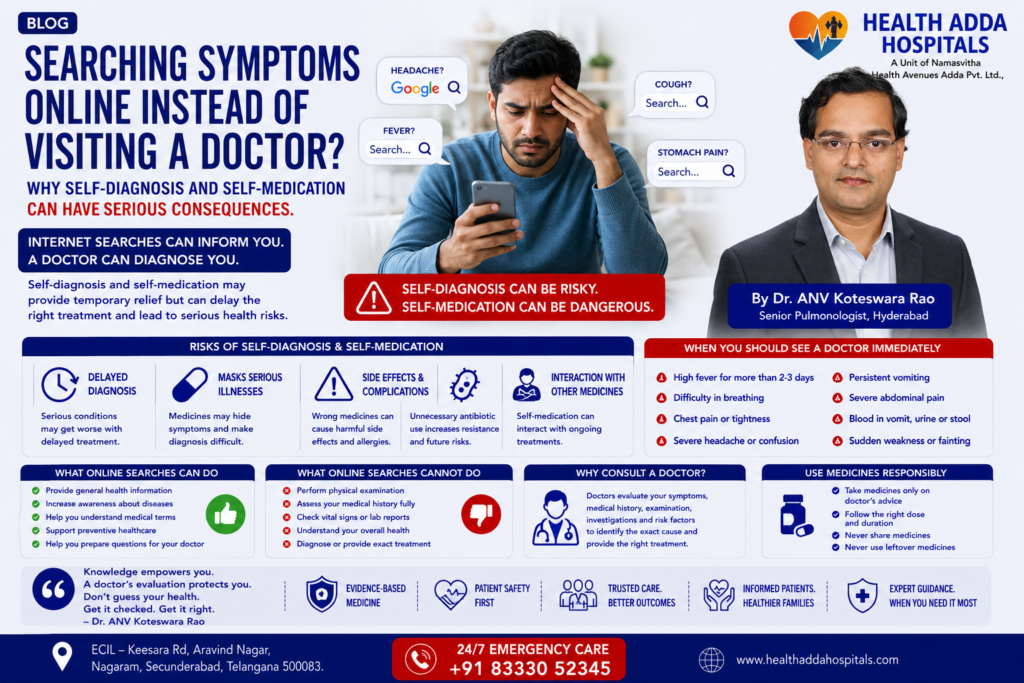
When You Should Never Rely on Self-Treatment
Seek immediate medical attention if you experience:
🚨 Chest pain
🚨 Difficulty breathing
🚨 Sudden weakness
🚨 High fever lasting several days
🚨 Severe abdominal pain
🚨 Persistent vomiting
🚨 Confusion
🚨 Blood in vomit, urine, sputum, or stool
These symptoms require professional medical evaluation.
What Online Health Information Is Good For
The internet can be helpful for:
✔️ Learning about diseases
✔️ Understanding medical terms
✔️ Preparing questions before appointments
✔️ Learning healthy lifestyle habits
✔️ Improving preventive healthcare awareness
Use online information to become an informed patient—not to replace medical consultation.
Why a Doctor’s Evaluation Is Different
A doctor considers much more than symptoms alone.
Medical evaluation includes:
- Complete medical history
- Physical examination
- Vital signs
- Laboratory investigations
- Imaging when needed
- Medication review
- Risk factors
- Family history
These details cannot be fully assessed through an online search or AI chatbot.
Why Patients Should Consider a Second Opinion
Sometimes patients remain uncertain even after searching online or receiving initial treatment.
A second opinion can:
- Confirm a diagnosis
- Explore additional possibilities
- Review treatment options
- Provide reassurance
- Support informed healthcare decisions
Seeking another professional opinion is a responsible part of modern healthcare.
How Health Adda Hospitals Supports Responsible Healthcare
At Health Adda Hospitals, patient education is encouraged alongside evidence-based medical care.
According to Dr. ANV Koteswara Rao, online information should help patients become better informed—but medical diagnosis and treatment should always be based on professional clinical evaluation.
The goal is not to discourage patients from learning, but to encourage them to combine knowledge with expert medical guidance.
Clinical Perspective
From a physician’s perspective, self-diagnosis and self-medication remain common reasons for delayed diagnosis.
According to Dr. ANV Koteswara Rao, patients often arrive after symptoms have worsened because they relied on internet searches or medications without understanding the underlying cause.
Timely medical evaluation improves diagnosis, treatment decisions, and patient outcomes.
Conclusion
Searching symptoms online has become a normal part of everyday life.
Learning about your health is a positive step.
However, diagnosing yourself and taking medicines without professional guidance can sometimes have serious consequences.
Use online information to educate yourself.
Use qualified healthcare professionals to diagnose and treat you.
That combination offers the safest path toward better health.
Why Trust This Guidance?
This article is reviewed by Dr. ANV Koteswara Rao, Senior Physician & Pulmonologist at Health Adda Hospitals, Hyderabad.
Health Adda Hospitals is committed to evidence-based medicine, patient education, preventive healthcare, and helping individuals make informed medical decisions through trusted clinical care.