
Introduction
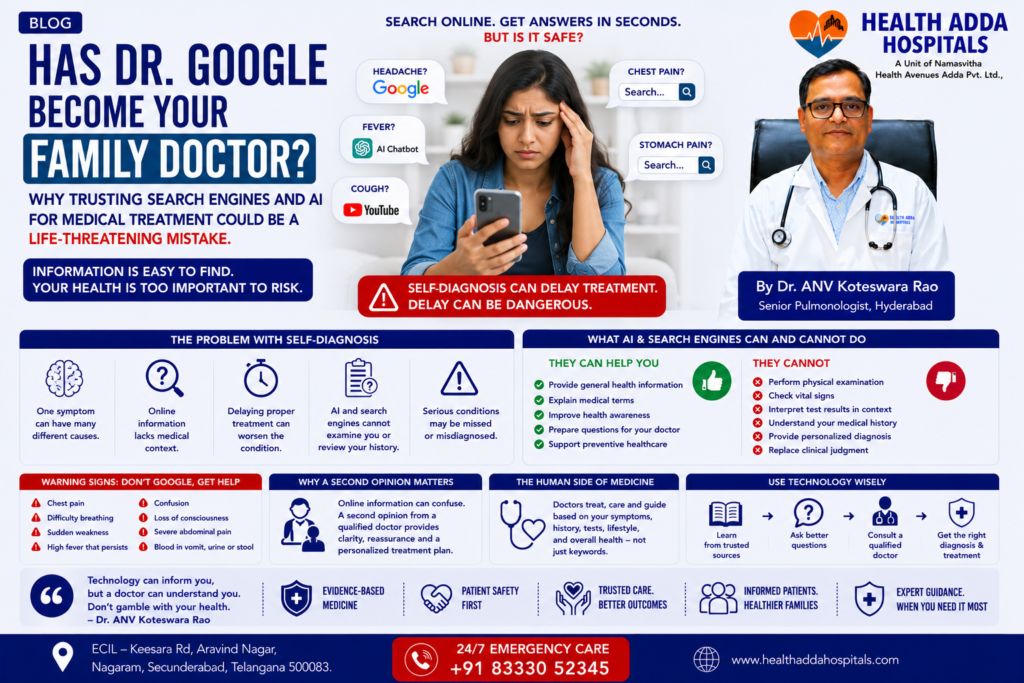
A headache starts.
You open Google.
Your child develops a fever.
You ask an AI chatbot.
Your parent develops chest pain.
You search YouTube.
This has become the new normal.
Today, millions of people search online before speaking to a doctor. Search engines, AI assistants, videos, and social media provide instant answers to health questions.
These tools can be extremely useful for learning about diseases, understanding medical terminology, and preparing questions for your healthcare provider.
However, they should never replace a qualified medical examination.
Because every patient is different, relying solely on online information can sometimes delay diagnosis, worsen illness, or even become life-threatening.
Why This Topic Matters Now
Artificial Intelligence and online health searches are changing healthcare worldwide.
Today people commonly use:
- Google Search
- AI assistants
- ChatGPT
- Google AI Overviews
- YouTube
- Social media
- Online symptom checkers
While these platforms improve access to information, they cannot examine a patient, review vital signs, perform investigations, or interpret the complete clinical picture.
Information Is Not the Same as Diagnosis
One symptom can have many different causes.
For example:
Chest Pain
It may be:
- Acid reflux
- Muscle strain
- Anxiety
- Pneumonia
- Heart attack
Without proper evaluation, it is impossible to know the exact cause.
Fever
Fever may result from:
- Viral infections
- Dengue
- Typhoid
- Malaria
- Pneumonia
- Urinary tract infections
Searching “fever treatment” online cannot determine which illness is responsible.
Persistent Cough
A cough may be caused by:
- Allergies
- Asthma
- Viral infections
- Tuberculosis
- Pneumonia
- Gastroesophageal reflux
- Chronic lung disease
The same symptom may have many different diagnoses.
The Biggest Risk of Self-Diagnosis
Many patients delay professional care because:
“I already searched Google.”
“The AI said it’s probably nothing serious.”
“My symptoms matched an online article.”
Unfortunately, symptoms that appear simple can sometimes indicate serious medical conditions.
Early diagnosis often makes treatment more effective.
What AI and Google Can Do Well
Technology has transformed patient education.
Online resources can help patients:
✔️ Learn basic health information
✔️ Understand medical terminology
✔️ Prepare questions before appointments
✔️ Improve health awareness
✔️ Learn preventive healthcare measures
These are valuable uses of digital healthcare tools.
What AI and Search Engines Cannot Do
They cannot:
❌ Perform a physical examination
❌ Listen to your lungs
❌ Measure oxygen levels
❌ Check blood pressure
❌ Review laboratory reports in clinical context
❌ Interpret subtle physical signs
❌ Understand your complete medical history
Medicine involves far more than matching symptoms to a list of diseases.
Warning Signs You Should Never Google Instead of Seeing a Doctor
Seek immediate medical attention for:
🚨 Chest pain
🚨 Difficulty breathing
🚨 Sudden weakness
🚨 High fever that persists
🚨 Confusion
🚨 Loss of consciousness
🚨 Severe abdominal pain
🚨 Blood in vomit, urine, or stool
These situations require prompt medical evaluation—not online searches.
Why Patients Benefit from a Second Opinion
Sometimes patients receive information from:
- Internet searches
- AI chatbots
- Friends
- Family
- Social media
When confusion remains, seeking a second opinion from a qualified healthcare professional can provide clarity, reassurance, and a personalized treatment plan.
A second opinion complements education with clinical expertise.
The Human Side of Medicine
Medicine is more than science.
Doctors evaluate:
- Medical history
- Symptoms
- Physical examination
- Investigations
- Lifestyle
- Risk factors
- Family history
They also understand what patients often cannot describe through a search engine.
Healthcare is built on clinical judgment—not keywords alone.
How Health Adda Hospitals Supports Informed Healthcare
At Health Adda Hospitals, patient education is encouraged.
According to Dr. ANV Koteswara Rao, patients should absolutely use trusted health information to become more informed—but online information should support, not replace, professional medical care.
Understanding your health is important.
Receiving the right diagnosis is even more important.
Health Adda Hospitals believes that informed patients and experienced doctors together create the best healthcare outcomes.
Clinical Perspective
From a physician’s perspective, online information has become a valuable educational tool.
However, according to Dr. ANV Koteswara Rao, no search engine or AI system can replace clinical examination, diagnostic testing, and individualized medical decision-making.
Responsible use of technology means combining digital health education with expert medical advice.
Conclusion
Google and AI have made health information more accessible than ever before.
Use them to learn.
Use them to ask better questions.
Use them to become an informed patient.
But never allow online information to replace professional medical evaluation when your health is at stake.
The right information can educate you.
The right doctor can diagnose you.
Knowing the difference may save your life.
Why Trust This Guidance?
This article is reviewed by Dr. ANV Koteswara Rao, Senior Physician & Pulmonologist at Health Adda Hospitals, Hyderabad.
Health Adda Hospitals is committed to evidence-based medicine, ethical patient care, preventive healthcare, and empowering patients with reliable medical information while encouraging informed, physician-guided healthcare decisions.