
Introduction
Medical emergencies can happen without warning. Whether it is severe breathing difficulty, chest pain, an accident, or a sudden health crisis, the quality of emergency care often plays a critical role in patient outcomes.
Many people assume that having an emergency department is enough. However, effective emergency care at hospitals depends on much more than simply keeping the department open 24 hours a day.
In Hyderabad, where healthcare demands continue to grow, understanding what makes emergency care effective can help families make informed healthcare decisions before emergencies occur.
Why Effective Emergency Care Matters
During emergencies, every minute can be important.
Effective emergency care helps:
- Support rapid medical assessment
- Improve patient safety
- Reduce treatment delays
- Enhance coordination between departments
- Improve healthcare outcomes
Therefore, hospitals must focus on speed, preparedness, infrastructure, and patient-centered care.
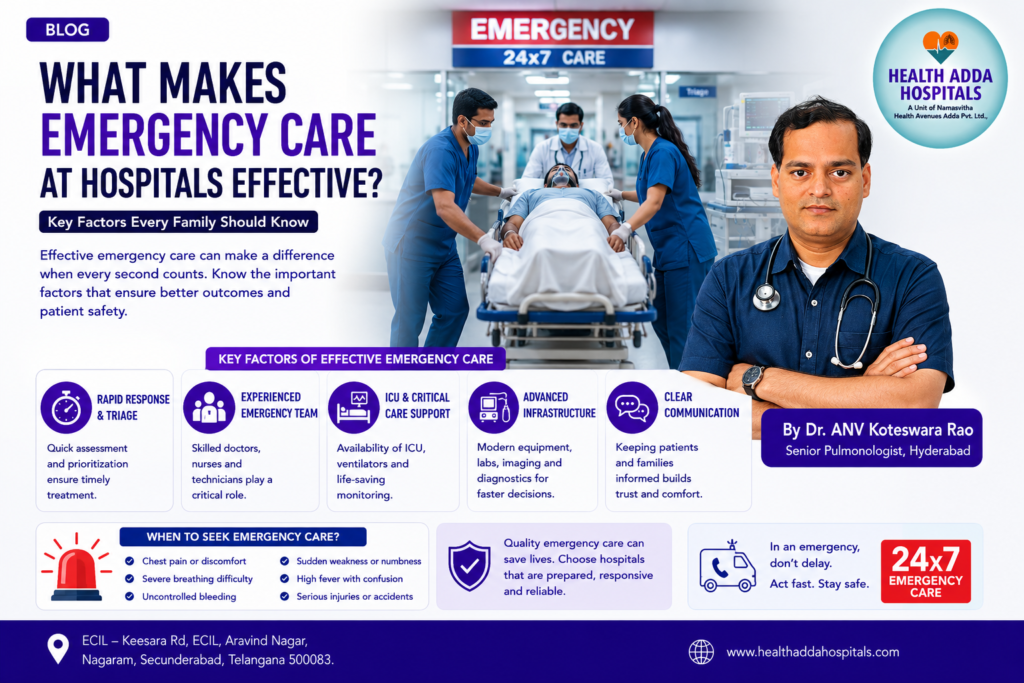
Effective Emergency Care Starts With Rapid Response
One of the most important indicators of emergency department quality is response time.
Key Rapid Response Elements
- Immediate patient assessment
- Fast triage systems
- Quick access to emergency physicians
- Efficient patient flow
Because emergencies are often time-sensitive, delays can affect healthcare outcomes.
Emergency Teams Play a Critical Role
An emergency department is only as effective as the professionals working within it.
Essential Emergency Care Professionals
- Emergency medicine physicians
- Critical care specialists
- Pulmonologists
- Cardiologists
- Trained nursing teams
- Emergency technicians
Therefore, experienced healthcare teams remain one of the strongest indicators of emergency department quality.
Why ICU Support Is Important
Serious emergencies often require critical care support.
Important Critical Care Facilities
- Intensive Care Units (ICU)
- Ventilator support
- Continuous monitoring systems
- Emergency life-support equipment
Hospitals with integrated ICU capabilities are often better prepared for complex emergencies.
Effective Emergency Care Requires Advanced Infrastructure
Modern emergency departments rely on technology and infrastructure.
Important Infrastructure Components
- Emergency diagnostic facilities
- Digital monitoring systems
- Laboratory services
- Imaging support
- Oxygen systems
Because rapid diagnosis supports faster decision-making, infrastructure plays a major role.
Communication Is a Key Part of Emergency Care
Patients and families often experience stress during emergencies.
Effective hospitals focus on:
- Clear communication
- Family updates
- Transparent information sharing
- Patient-centered care
Therefore, communication quality contributes significantly to overall patient experience.
What Families Should Look For in an Emergency Department
Before an emergency happens, families should understand the capabilities of nearby hospitals.
Questions to Consider
Does the Hospital Provide 24/7 Emergency Services?
Continuous emergency availability is essential.
Is ICU Support Available?
Critical care services can be important during severe emergencies.
Are Specialists Available?
Access to specialists improves emergency care coordination.
Does the Hospital Have Ambulance Support?
Emergency transportation can significantly affect response times.
Why Emergency Preparedness Matters
Prepared hospitals often respond more effectively during crises.
Important Preparedness Factors
- Staff training
- Emergency drills
- Equipment readiness
- Disaster response planning
- Infection-control systems
Therefore, preparedness remains a key indicator of emergency care quality.
Common Emergencies Seen in Hyderabad
Healthcare professionals frequently encounter:
- Respiratory emergencies
- Chest pain and cardiac concerns
- Road traffic injuries
- High fever and infections
- Stroke-related symptoms
- Trauma cases
Because Hyderabad continues to grow rapidly, emergency healthcare demand continues to increase.
How Health Adda Hospitals Supports Emergency Healthcare Awareness
At Health Adda Hospitals, patient safety, healthcare awareness, and emergency preparedness remain important priorities.
According to Dr. ANV Koteswara Rao, many families evaluate emergency care only after a crisis occurs. However, understanding emergency department quality beforehand helps patients make informed healthcare decisions when time matters most.
Healthcare awareness can support better preparedness and greater confidence during emergencies.
Clinical Perspective
From a healthcare standpoint, effective emergency care combines:
- Rapid assessment
- Skilled professionals
- Advanced infrastructure
- Patient-centered communication
- Critical care support
According to Dr. ANV Koteswara Rao, hospitals that integrate these components often provide stronger emergency care systems and better patient experiences.
Conclusion
Effective emergency care at hospitals involves much more than simply keeping emergency services open around the clock.
Response times, skilled professionals, ICU support, infrastructure, communication, and preparedness all contribute to emergency department quality.
As Hyderabad’s healthcare landscape continues to evolve, understanding what makes emergency care effective can help families make informed healthcare decisions when they matter most.